Best walking aids for stroke survivors
The wrong aid doesn't just fail to support you — it teaches your brain the wrong compensation pattern. Here is how to choose, what to look for, and the models I recommend.
Key Takeaways
- The Drive Medical Nitro Rollator is the rollator upgrade worth making.
- The wrong aid teaches your brain the wrong compensation pattern.
- Hold the cane on your strong side and set it to the correct height.
- A walker beats a cane when balance and weight-bearing are still unreliable.
- Progress through aids over time rather than clinging to one too long.
The progression most survivors actually follow
Parallel bars in acute care. Front-wheeled walker in inpatient rehab. Quad cane in early outpatient. Single-point cane or rollator at home. No aid or context-dependent aid at 6–18 months.
Not everyone follows that path. Some skip aids entirely. Some plateau at the quad cane — and that is not a failure; it is an honest adaptation. The key question at each step: does this aid let you walk more normally, or does it create a compensated pattern your brain then has to unlearn?
Quad cane vs single-point cane — what actually differs
A single-point cane offloads the hip and knee on the affected side but does almost nothing for ankle instability. A quad cane provides a stable platform that doesn't tip when planted and can bear significantly more weight. The tradeoff: slower cadence and requires flat surfaces.
Use a quad cane when you need it to bear real weight during stance and your ankle is unstable. Transition to single-point when you're using the quad for balance only — not load-bearing — and gait speed is within functional range.
Contralateral use: the cane goes in the hand opposite the affected leg, not on the affected side. This is the biomechanically correct position that reduces hip joint load during stance. Most survivors instinctively do it wrong.
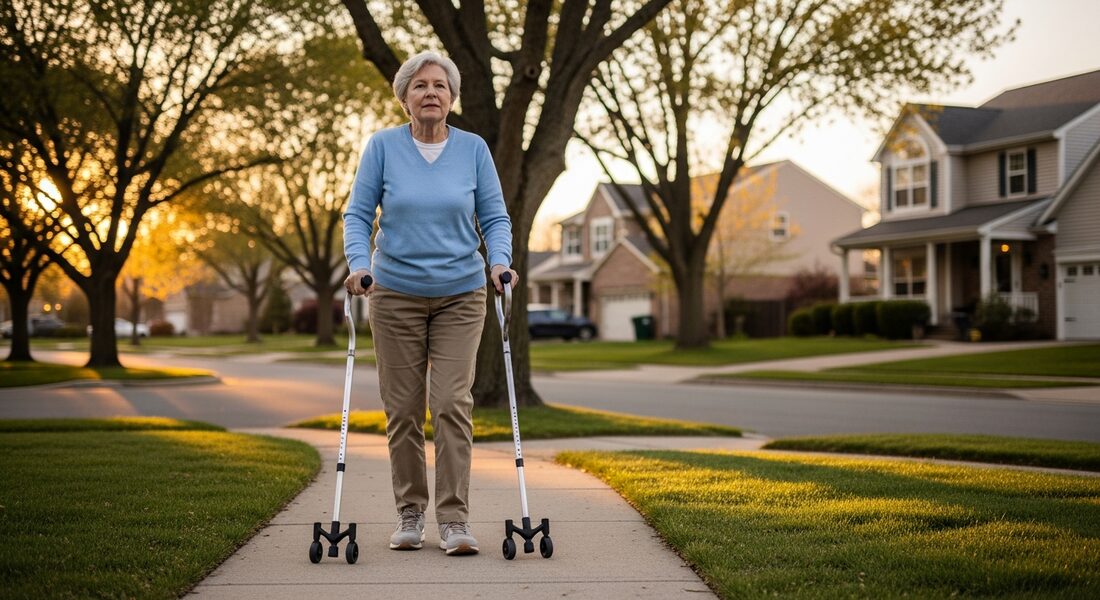
Walking aids compared at a glance
These are the three aids recommended in this post. Use the table to match the aid to your current balance and weight-bearing needs, then read the details below.
| Product | Best for | Key spec | Approx. price |
|---|---|---|---|
| HurryCane Freedom Edition | Single-point support on uneven surfaces | Self-adjusting pivoting base, folds flat, multiple heights | See current price |
| Hugo Mobility Offset Quad Cane | Load-bearing balance in early outpatient phase | Offset handle, large stable base, height-adjustable | See current price |
| Drive Medical Nitro Rollator | More support than a cane without losing speed | Euro-style 4-wheel, 13 lbs, loop brakes, padded seat | See current price |
Three aids I recommend
Affiliate links — small commission at no cost to you.
Pivoting base that self-adjusts to uneven surfaces — the key differentiator. Folds flat. Multiple heights. Already in the Recovery Store.
Check Current Price on Amazon ↗Offset handle positions weight over the base center — more natural arm alignment than in-line quad canes. Height-adjustable. Large base. The quad cane I'd buy for the early outpatient phase.
Check Current Price on Amazon ↗Euro-style 4-wheel, 13 lbs, loop brakes, padded seat, storage pouch. For survivors who need more support than a cane but want speed over a traditional walker.
Check Current Price on Amazon ↗How to set cane height
- Stand upright, arms at sides. Top of handle = wrist crease.
- Holding the cane with a relaxed grip, elbow should be flexed 20–30 degrees. Too straight = no shock absorption. Too bent = leaning on the cane instead of the floor.
- Cane in the hand opposite the affected side — contralateral.
- If wearing an AFO that shortens the affected leg slightly, adjust height to maintain level shoulder alignment.
When a walker beats a cane
A cane requires balance. If your balance can't trust a single support point, a walker gives bilateral stability. The Kaye postural control walker adds trunk support for more severe impairment. The standard front-wheeled walker is the workhorse of inpatient rehab.
If you are on a walker and your PT hasn't discussed transition to a rollator or cane, ask. Most survivors who plateau there simply haven't had the conversation.
Frequently asked questions
Should I hold my cane on my strong or weak side?
Strong side — the hand opposite your affected leg. This is the biomechanically correct position that reduces hip joint load during stance. Most survivors instinctively use the cane on the affected side; that provides some balance help but doesn't offload the hip correctly.
When can I stop using a walking aid after stroke?
When your gait speed, balance confidence, and ankle stability allow you to walk safely without it — not before. Your PT should lead this decision with functional gait assessments. Rushing independent ambulation before balance is ready significantly increases fall risk.
Is a rollator better than a walker for stroke survivors?
In most cases, yes — for survivors past the acute inpatient phase. A rollator allows a more natural walking pattern, supports a seat when needed, and moves with you rather than breaking stride. The Drive Nitro is the most common rollator in outpatient stroke rehab.
Can I use a walking cane on stairs?
With a handrail, yes. Cane in the strong-side hand, strong leg goes up first. Without a handrail, a quad cane is significantly more stable. Work on stair training with your PT before attempting unsupervised.
Drive Medical Nitro Rollator — the rollator upgrade worth making
Euro-style, 13 lbs, loop brakes, padded seat. For survivors who need more than a cane and won't compromise on speed.
Check Current Price on AmazonThe gait rebuild is in the book
THE ULTIMATE STROKE RECOVERY REVOLUTION walks through every stage of gait recovery — acute, subacute, chronic — and the daily routine that keeps momentum building.
Get the bookStart your recovery free.
Daily routine. AI coach. 66-day challenge. Built by a survivor for survivors.
Create free account