Best Balance Boards for Stroke Recovery (2026 Guide)
Stroke Recovery Blog

Best balance boards for stroke recovery

Balance training after stroke isn't about not falling — it's about rebuilding the sensory feedback loops that stroke severed. Here is what works, what doesn't, and the boards I recommend.

As an Amazon Associate, Stroke Recovery Academy earns from qualifying purchases. No cost to you.
Nick Kremers
Written by Nick Kremers · 7-year stroke survivor.
Last reviewed: 2026-07-28
2 min read · 377 words
Medically reviewed by SRA clinical advisory team

Why stroke destroys balance — the actual mechanism

Balance requires three systems working together: vision (where the horizon is), vestibular (head position in space), and proprioception (where your joints are relative to each other). Stroke can impair all three, but proprioception — the unconscious position sense from the ankle, knee, and hip — is almost universally affected.

The proprioceptive pathway from the ankle to the brain is damaged. The brain is getting inaccurate or absent information about where the foot is during stance. A balance board creates the movement demands that force those pathways to fire repeatedly — the same neuroplasticity principle that drives all stroke recovery.
Rocker vs wobble board — different perturbations for different goals

A rocker board tilts in one plane — anterior-posterior (front-to-back) or mediolateral (side-to-side). Simpler, more controlled, better for early-stage balance training and for isolating specific ankle movements.

A wobble board tilts in all planes simultaneously — more unstable, more neurologically demanding. Better for intermediate-to-advanced training when single-plane stability is already established.

Start rocker. Progress to wobble. Using a wobble board before rocker stability is established is how people fall.

Alternative tools for balance and proprioception

Balance boards are not the only proprioceptive tools. A balance pad creates gentle instability without the fall risk of a rocker or wobble board. A slant board maintains ankle dorsiflexion range, which is prerequisite to stable standing. These tools work alongside the balance board, not instead of it.

High-Density TPE Balance Pad

Foam balance pad with non-slip surface. Safer than a board for early-stage proprioceptive retraining. Also in the Recovery Store.

Check Current Price on Amazon ↗
Revbalance 101 v2 Balance Board

True wobble board with 360-degree instability. The next step after rocker board mastery. Also in the Recovery Store.

Check Current Price on Amazon ↗
Adjustable Wooden Slant Board — 5-Angle Calf Stretcher

5-angle progression for controlled dorsiflexion stretching. Maintains ankle range of motion that balance work depends on. Also in the Recovery Store.

Check Current Price on Amazon ↗

The balance board progression for stroke survivors

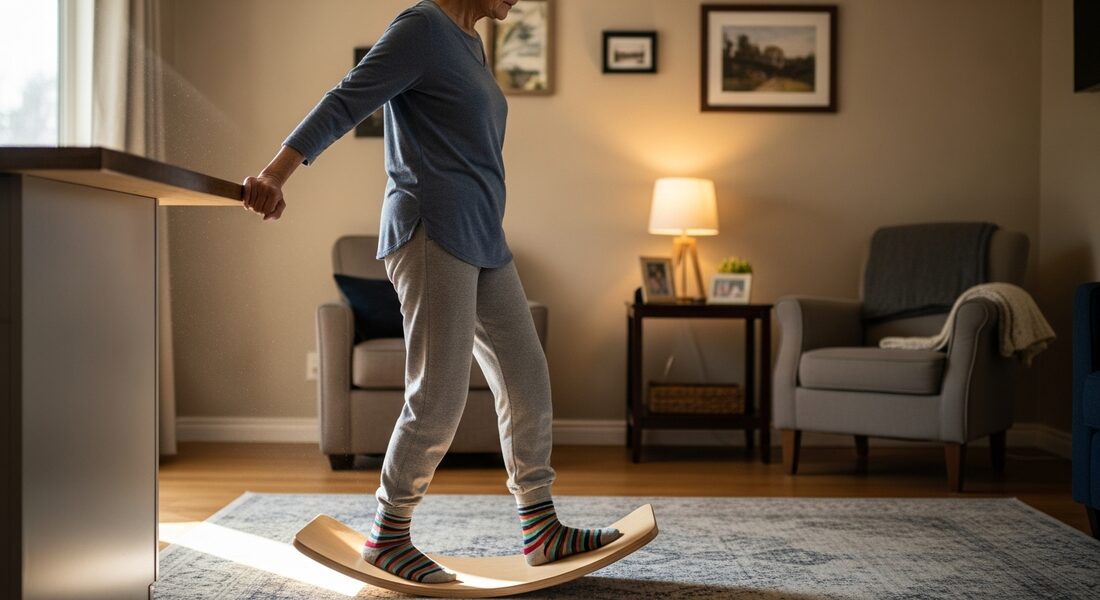
Stroke survivor standing on a balance board holding a counter for support
The board creates the perturbation the brain needs to rebuild the map — but only with a safety setup nearby.

Combine with ankle work for compounding effect

Balance board training combined with ankle strengthening (TheraBand dorsiflexion work) produces significantly faster balance gains than either alone. The strengthening builds the actuators; the balance board trains the control system. Do both in the same session.

Frequently asked questions

Is a balance board safe for stroke survivors?

With a safety setup (sturdy chair, counter, or wall within arm's reach), yes — for survivors past the acute phase with adequate standing tolerance. Start with bilateral standing on a flat surface before introducing any rocking motion. Never use a balance board without a fall-prevention setup nearby.

How long should I stand on a balance board after stroke?

Start at 1 minute per set, 3 sets per session. Total 5–10 minutes of balance board time per session. This is shorter than healthy-population balance training — post-stroke fatigue and concentration demands make longer sessions counterproductive early on. Build to 20–30 minutes over 8–12 weeks.

Can I use a balance board if I wear an AFO?

Yes — start with the AFO on the affected foot. The AFO provides ankle stability that makes the board more controllable while still providing the proprioceptive stimulus through the knee and hip. As ankle stability improves, trial brief periods without the AFO on the board in a supervised setting.

Should I do balance board training with eyes open or closed?

Always start eyes open. When you can maintain bilateral board balance with eyes open for 3 x 1 minute comfortably, trial eyes closed — briefly at first. Eyes-closed balance is significantly harder after stroke because you've been compensating with vision for impaired proprioception. It is also more neurologically beneficial.

StrongTek Professional Balance Board

Rocker and wobble modes. Anti-slip. 300 lb capacity. The balance board most commonly used in stroke home rehab.

Check Current Price on Amazon
Also in the Recovery Store. Affiliate link — small commission at no cost to you.

The full balance rebuild system is in the book

THE ULTIMATE STROKE RECOVERY REVOLUTION covers the complete proprioceptive retraining progression — from first standing to advanced dynamic balance — with the daily system that makes it stick.

Get the book

Start your recovery free.

Daily routine. AI coach. 66-day challenge. Built by a survivor for survivors.

Create free account