Best Standing Desks for Stroke Survivors: Return to Work, Posture, and Active Recovery
Stroke Recovery Blog

Best Standing Desks for Stroke Survivors and Return to Work

Sitting eight hours a day with hemiplegia reinforces every asymmetry you're trying to correct in PT. A height-adjustable desk isn't a luxury — it's a functional tool for recovering while working.

As an Amazon Associate, Stroke Recovery Academy earns from qualifying purchases. No cost to you.
Nick Kremers
Written by Nick Kremers · 7-year stroke survivor.
Last reviewed: 2026-07-28
1 min read · 0 words
Medically reviewed by SRA clinical advisory team

Why a regular desk works against stroke recovery

I went back to part-time desk work at eight months post-stroke. Standard fixed-height desk, standard chair. Within two weeks my affected shoulder was worse, my trunk was listing right, and my PT was asking what changed. What changed was six hours per day of asymmetric loading in a fixed position — the affected arm resting at an angle that maintained internal rotation, the trunk habitually shifting to the stronger side, the affected leg hanging in less-than-ideal position because the seat height was wrong for my gait mechanics.

Height-adjustable desks address this by giving you options. Alternate between sitting and standing. Set the height for your affected arm to rest at desk level rather than hanging. Stand during video calls to get bilateral weight-bearing. None of this replaces PT — but all of it stops compounding the asymmetries that PT is trying to reduce.
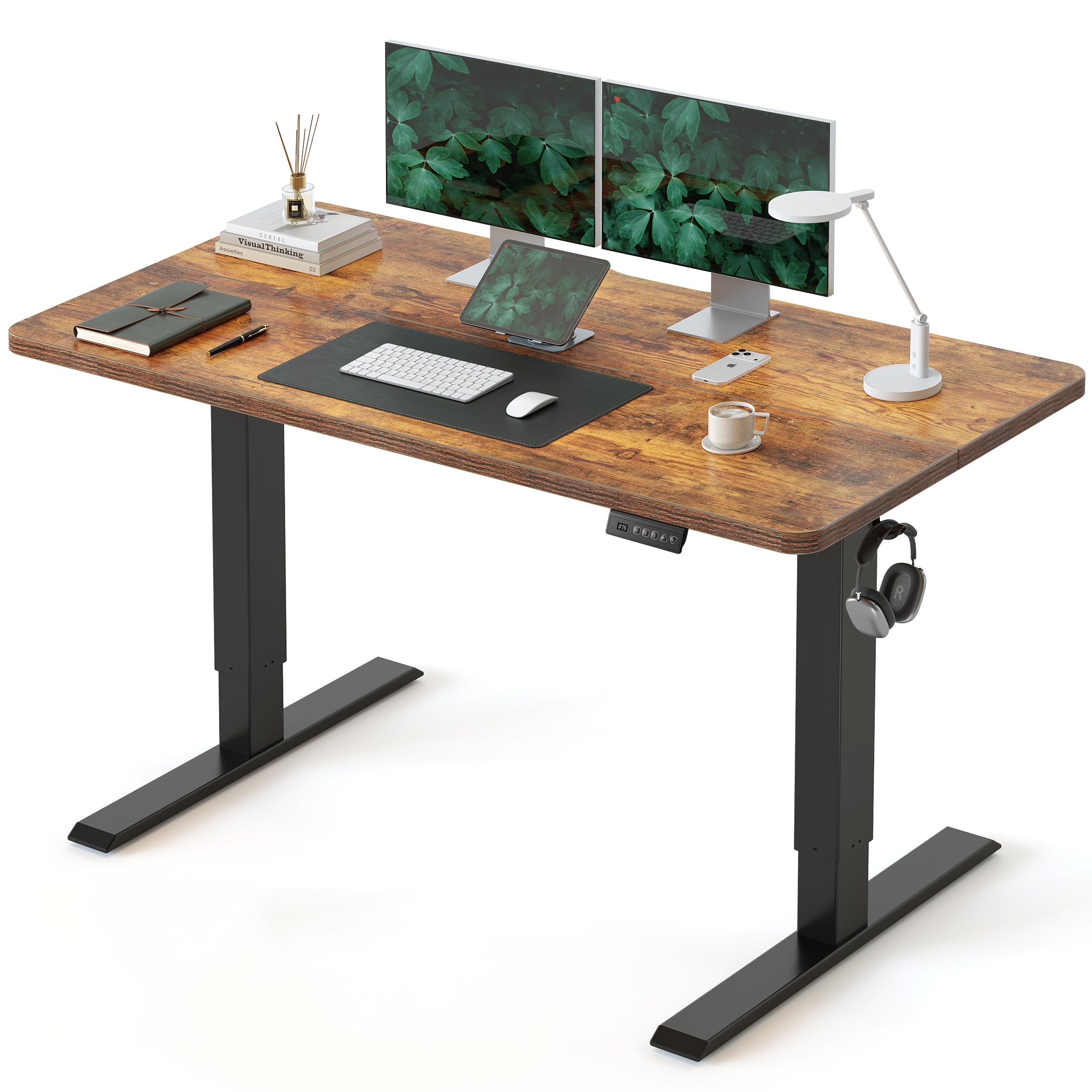
FlexiSpot E7 — the best value electric sit-stand desk

FlexiSpot E7 Electric Height Adjustable Standing Desk

Dual motor, 4 memory presets, anti-collision, 22.8"–48.4" range. Best value electric standing desk for stroke return-to-work setup.

Check Current Price on Amazon ↗

The FlexiSpot E7 is the most-reviewed electric standing desk in the $350–$500 range that consistently shows up in ergonomic and rehabilitation contexts. Dual-motor lift, 355 lb weight capacity, height range of 22.8"–48.4" that works for seated use by shorter survivors and standing use up to 6'4". The anti-collision detection stops the desk if it encounters an obstacle — important if one arm is reaching toward the desk when you hit the up button.

Four programmable height memory positions. Set one for your optimal seated height (affected forearm resting flat on the desk surface), one for standing height, one for a mid-height that works if you're sitting on a stool during fatigue periods. One-button transitions mean you actually use the adjustment instead of avoiding it because it's inconvenient.

SHW Electric Height Adjustable Desk — the budget option

SHW Electric Height Adjustable Desk

Single motor, memory presets, 28"–45" range, 176 lb capacity. Best budget option for survivors who primarily work seated with periodic standing.

Check Current Price on Amazon ↗

For survivors who need the functional benefit of height adjustment without the FlexiSpot price point, the SHW electric desk delivers the core feature — motorized height adjustment with memory presets — at $200–$260. Single motor (slower transitions, lower weight capacity at 176 lbs), but fully adequate for a standard workstation setup. The height range of 28"–45" covers most sitting and standing configurations.

The limitation: lower build quality is noticeable in the frame stability at standing height. If you're using the desk primarily at the seated position (which is appropriate for most stroke survivors in the first year), this doesn't matter. If you need a rock-solid standing surface for significant manual work, the FlexiSpot E7 is worth the extra spend.

Setting up the workstation for stroke recovery

Seated height: Elbows at desk level — the affected forearm should rest flat on the surface, not hanging. This reduces the gravitational pull on the shoulder that contributes to subluxation pain during extended desk work.

Monitor placement: Directly ahead, not offset to the stronger side. The natural tendency post-stroke is to position everything toward the stronger side for ease of use — this reinforces neglect of the affected side and trains inattention to it.

Keyboard and mouse: Consider a split keyboard that positions the hands at shoulder width — this maintains the affected arm in a more neutral position. If the affected hand can't use the keyboard reliably yet, one-handed keyboard adaptations and voice-to-text (Dragon, Windows Voice Access) close the functional gap.

Standing periods: Start with 5–10 minutes standing per hour. Standing fatigue post-stroke is real and hits faster than pre-stroke. Build the standing tolerance the same way you build any other tolerance — progressively, with rest.

Frequently asked questions

When can I return to desk work after stroke?

Varies enormously with stroke severity and job demands. Mild-to-moderate survivors often return to modified duty at 3–6 months with workplace accommodations. The vocational rehabilitation system (state VR programs in the US) provides job assessment, workstation modification funding, and return-to-work planning — access it before buying anything. Your physiatrist or neurologist provides the medical clearance piece.

Does standing at a desk help stroke recovery?

Standing provides bilateral weight-bearing through the affected leg, challenges trunk stability, and interrupts the prolonged asymmetric sitting pattern that worsens posture. Even 5-minute standing intervals hourly have measurable effects on circulation and spasticity in clinical settings. More is better up to the fatigue limit — which is lower than pre-stroke for most survivors.

Should I get an anti-fatigue mat for standing after stroke?

Yes. An anti-fatigue mat is essential for post-stroke standing tolerance — the padded surface reduces the impact stress on the affected leg and makes sustained standing meaningfully less fatiguing. Topo Comfort Mat or similar ergonomic mats are worth the $60–$80.

Can I claim a standing desk as a disability accommodation after stroke?

Yes — in the US, the ADA requires employers to provide reasonable accommodations for qualified employees with disabilities. A height-adjustable desk for a stroke survivor with hemiplegia or fatigue is a standard, well-established accommodation. Request it through your HR/ADA coordinator with a physician letter of support. Some employers fund it entirely; others cost-share.

My affected arm can't use a standard mouse. What works?

Vertical mouse (reduces forearm pronation), trackball (no wrist movement required), head-tracking mouse (for minimal arm function), or switch-adapted mouse for one-switch scanning. Assistive technology specialists (occupational therapists with AT certification) evaluate and match the solution to your actual motor profile — don't trial-and-error expensive AT devices without that assessment.

FlexiSpot E7 Electric Standing Desk

Check Current Price on Amazon
Best electric standing desk for stroke return-to-work. Dual motor, 4 memory presets. Affiliate link.

Return to work and identity are in the book

THE ULTIMATE STROKE RECOVERY REVOLUTION covers the return-to-work journey, the identity crisis that comes with it, and the practical strategies that make it sustainable.

Get the book

Start your recovery free.

Daily routine. AI coach. 66-day challenge. Built by a survivor for survivors.

Create free account