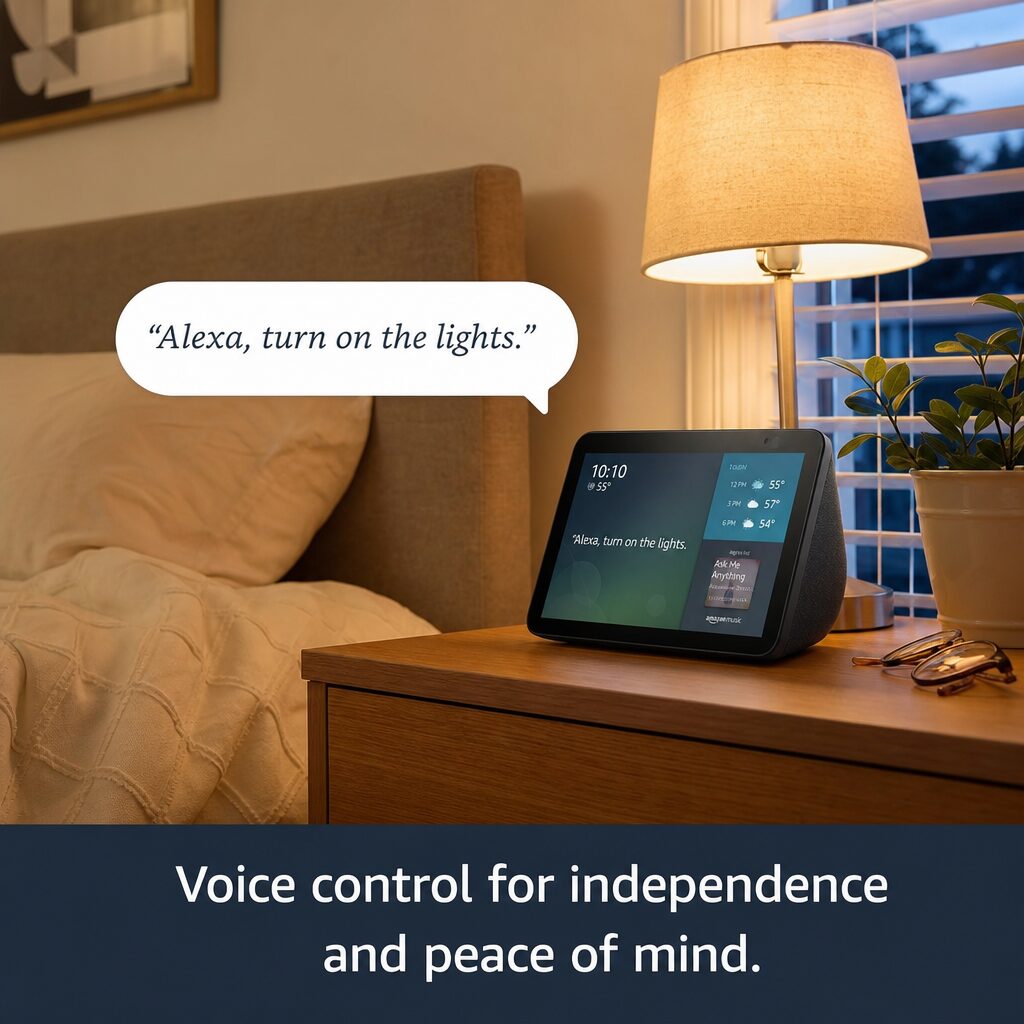
Amazon Echo Show smart speaker on a nightstand for voice-controlled independence after stroke
Stroke Recovery Blog

Best Smart Home Devices for Stroke Survivors

Controlling your home without two working hands, clear speech, or unlimited energy isn't a luxury — it's a functional independence goal. Here's the technology that closes the gap.

As an Amazon Associate, Stroke Recovery Academy earns from qualifying purchases. No cost to you.
Nick Kremers
Written by Nick Kremers · 7-year stroke survivor.
Last reviewed: 2026-07-28
1 min read · 0 words
Medically reviewed by SRA clinical advisory team

Why smart home tech matters for stroke recovery

Six months post-stroke I couldn't reliably operate my thermostat, unlock my front door for a home health aide, or turn off a light across the room without a full trip across unstable ground. These aren't trivial inconveniences — they're independence losses that compound fatigue, create safety risks, and grind on dignity in ways that don't show up on a Fugl-Meyer assessment.

Smart home technology addresses the asymmetry between cognitive ability and physical execution. Most stroke survivors have intact intelligence, partially intact speech, and severely limited bilateral motor function. Voice control and automation bypass the motor bottleneck entirely. This is assistive technology that doesn't look like assistive technology — and that matters for motivation.
Amazon Echo Show 8 — the control center that works

Amazon Echo Show 8 (2nd Gen)

8" touchscreen + Alexa voice control, video calls, Drop In, large UI elements. Best smart home hub for stroke survivors — accessible for both voice and touch.

Check Current Price on Amazon ↗

The Echo Show 8 is the sweet spot for stroke survivors: a 8" touchscreen with large, accessible UI elements plus full Alexa voice control. Voice commands handle lights, thermostat, timers, calls, video calls, music, weather, medication reminders. The touchscreen is a fallback when voice commands aren't working well — which matters for survivors with aphasia or dysarthria who have good days and bad days for verbal communication.

The camera enables video calling without requiring a phone — critical for survivors who struggle with small touchscreen interfaces. Drop In feature allows family caregivers to check in without the survivor needing to answer. The Show 8's screen size is the minimum that makes the UI accessible with motor impairment; the Show 5 is too small for reliable touch interaction with hemiparetic hands.

Amazon Echo Show 5 — bedside independence

Amazon Echo Show 5 (2nd Gen)

5.5" touchscreen, compact bedside size, Alexa. Best as a satellite device in the bedroom for nighttime independence.

Check Current Price on Amazon ↗

The Echo Show 5 paired with the Echo Show 8 creates a two-zone setup: main living area (Show 8) and bedside (Show 5). Nighttime independence — medication alarms, light control without getting up, emergency calls, sleep sounds for post-stroke insomnia — is disproportionately valuable. The Show 5 is compact enough for a nightstand and still has a screen for video calling family in the morning before getting up.

Don't try to use the Show 5 as a primary device — the 5.5" screen is too small for reliable touch with motor impairment. It's a bedside satellite, not a hub.

Smart plugs, smart lights, and video doorbells

Ring Video Doorbell (2nd Gen)

View and speak to visitors through Echo Show without going to the door. Critical for survivors with gait issues or who live alone.

Check Current Price on Amazon ↗

Smart plugs: A $10–$15 Alexa-compatible smart plug turns any lamp or appliance into a voice-controlled device. Start here before buying dedicated smart bulbs — it's the lowest-friction way to get voice control on existing fixtures. Kasa and Amazon Basics both make reliable units.

Smart lights: Philips Hue or similar let you control brightness and color by voice — useful for post-stroke light sensitivity where the overhead might be too harsh but reaching a dimmer requires crossing the room. "Alexa, dim the living room to 30%" is a real quality-of-life improvement.

Video doorbell: The Ring Video Doorbell lets a survivor see and speak to anyone at the door through the Echo Show without walking to the door. For survivors with gait issues, fatigue, or who live alone, this is a genuine safety and independence tool — not just a convenience gadget.

Frequently asked questions

Will Alexa understand me if I have dysarthria after stroke?

Alexa's speech recognition has improved significantly for atypical speech. Many survivors with mild-to-moderate dysarthria report reliable recognition after the system learns their voice pattern. Severe dysarthria may require supplementing with touch-based control (the Echo Show screen). Worth trying — you can return it if voice recognition is too unreliable.

What's the best setup for a stroke survivor living alone?

Echo Show 8 in the main living area, Echo Show 5 at the bedside, Ring doorbell, smart plugs on key lamps, and a smart thermostat. Total cost: $300–$400. The independence and safety value of that setup is hard to overstate for someone living alone post-stroke.

Can smart home devices help with post-stroke cognitive issues?

Yes — Alexa's reminder system is genuinely useful for medication management, scheduled activity cues, and appointment reminders. Cognitive fatigue means post-stroke survivors benefit from offloading working memory to external systems. "Alexa, remind me to take my aspirin at 8 AM" is a real clinical tool.

My caregiver wants to check on me but I want privacy. Can smart home devices handle that?

Alexa Drop In can be restricted to announced calls only (normal video calls) rather than the unannounced check-in mode. The survivor controls who has Drop In permissions. This is a worth-it conversation to have — the safety value of easy caregiver check-ins is real, and the privacy settings can be calibrated to a level both parties accept.

Is Alexa accessible for one-handed operation?

Primarily voice-operated by design — one-handed by default. The Echo Show touchscreen requires touch for some interactions; all of those have voice equivalents. For the occasional gesture (swiping through a playlist, adjusting a slider), the Show's touch targets are large enough for most hemiparetic hands with adequate active arm function.

Amazon Echo Show 8

Check Current Price on Amazon
Best smart home hub for stroke survivors. Voice + touchscreen, video calls, Drop In. Affiliate link.

Independence strategies are in the book

THE ULTIMATE STROKE RECOVERY REVOLUTION covers home adaptation, adaptive technology, and the practical strategies that rebuild independence without waiting for full physical recovery.

Get the book

Start your recovery free.

Daily routine. AI coach. 66-day challenge. Built by a survivor for survivors.

Create free account