Best Pedal Exercisers & Mini Exercise Bikes for Stroke Patients
Stroke Recovery Blog

Best pedal exerciser and mini exercise bike for stroke patients

Cycling motion is one of the earliest things stroke survivors can do on the affected leg — but only the right type of device captures the full benefit. Here is the breakdown.

As an Amazon Associate, Stroke Recovery Academy earns from qualifying purchases. No cost to you.
Nick Kremers
Written by Nick Kremers · 7-year stroke survivor.
Last reviewed: 2026-07-28
3 min read · 596 words
Medically reviewed by SRA clinical advisory team

Why pedaling works for stroke recovery

Cyclical lower limb movement activates the same neural circuits involved in walking — the central pattern generators (CPGs) that produce rhythmic, alternating leg movements. After stroke, these circuits are partially disconnected. Pedaling provides a rhythmic, bilateral, lower-demand activation that starts to restore the rhythm without the full balance demands of walking.

This is why cycling is often one of the first weight-bearing-equivalent activities in inpatient rehab. The fixed trajectory of the pedal helps the affected limb complete a movement it couldn't execute independently — the same principle as the EMG glove for the hand.

Active vs passive pedaling — the difference matters

Passive motorized pedaling (the unaffected leg drives the affected leg, or the device does all the work) provides sensory input and range of motion — valuable in early recovery or with dense paralysis. It is not the same as active pedaling.

Active pedaling — where the affected leg contributes voluntarily to the movement, even partially — produces cortical activation and motor learning. If you can actively pedal, actively pedal. Use motor imagery during passive cycling to get some cortical benefit when active participation isn't yet possible.

The protocol for stroke-specific use

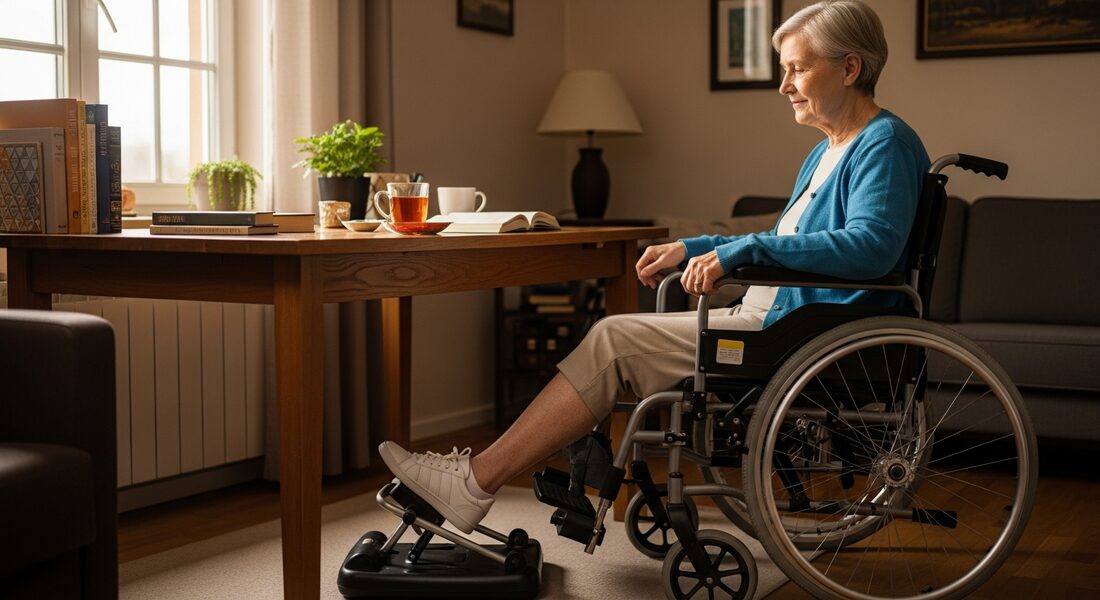
Stroke survivor using a pedal exerciser under a desk at home
Start seated, start slow, start today — the cycling motion rebuilds the same neural circuits walking uses.

What a pedal exerciser won't do

It won't replace walking. The gait pattern — weight shift, stance phase, heel strike, push-off — requires vertical loading that a seated pedal device doesn't provide. Use the pedal exerciser to build base endurance and rhythmic activation, then take that to walking therapy.

It won't resolve foot drop. The dorsiflexion component of pedaling is minimal compared to what's required for walking. Address drop foot with your AFO and ankle-specific work.

How the pedal exerciser fits in the actual daily routine

At year one, the DeskCycle sat under my desk during every Zoom call, every phone call, every reading session. It was not a workout — it was a background activity. Ten minutes at a time, zero resistance, slow and rhythmic. The affected leg participated maybe 30% of the time by my estimate. The other 70% the right leg was driving the rhythm.

By year two, I was up to 25 minutes per session at resistance two or three, and the affected leg was contributing most of the time. I could tell by the fact that I could stop pedaling and restart with just the affected leg initiating — that was not possible in the first six months.

The utility of the device was not as a workout. It was as a way to accumulate movement repetitions in otherwise dead time. If I pedaled during every video call for a year, that was hundreds of hours of lower limb activation that would not have happened otherwise. At the neural level, that compound interest shows up.
Pairing with upper body work for efficiency

The most efficient use of 30 minutes of pedal time: do your hand therapy simultaneously. Putty work, finger extensions with the rubber band, grip trainer squeezes — these require no attention to your legs and add zero fatigue load to the cycling session.

Two-for-one recovery time is the principle. The pedal exerciser runs the lower body rhythm on autopilot while your hands do concentrated, high-repetition work. Most survivors underestimate how much of their day can be used this way.

Frequently asked questions

Can I use a pedal exerciser if my affected leg barely moves?

Yes — start with minimal or zero resistance and let the unaffected leg drive the rhythm. The affected leg will follow passively, and you should actively attempt to contribute to the movement on every stroke. Even passive cycling with motor imagery provides more benefit than no movement at all.

How long should I pedal after stroke?

Start at 10 minutes twice daily. Add 5 minutes per session every two weeks. Target 30 minutes twice daily by week 8. This is a conservative progression that respects post-stroke fatigue — the most common reason survivors stop using equipment they bought.

Should I pedal with or without shoes?

With shoes, and specifically with your AFO if you wear one. The AFO holds the ankle in neutral during the cycling motion, which both prevents foot drop on the downstroke and provides more accurate proprioceptive feedback. Strapped pedals also help keep the affected foot on the pedal.

DeskCycle Under-Desk Pedal Exerciser

Calibrated magnetic resistance, whisper-quiet, works at slow RPM. The pedal exerciser most commonly used in stroke home rehab programs.

Check Current Price on Amazon
Also in the Recovery Store. Affiliate link — small commission at no cost to you.

The lower body rebuild is in the book

THE ULTIMATE STROKE RECOVERY REVOLUTION covers the complete lower limb progression — from seated cycling to walking to the advanced gait protocol used by 7-year survivors.

Get the book

Start your recovery free.

Daily routine. AI coach. 66-day challenge. Built by a survivor for survivors.

Create free account