Best Exercise Bikes for Stroke Patients: Recumbent, Pedal & Passive Options
Stroke Recovery Blog

Best exercise bikes for stroke patients

After my stroke at 36, my left leg was too weak to push a regular bike. I started on a passive motorized cycle — the pedals moved my legs, not the other way around. Six months later I graduated to active resistance. Here is the full progression and the equipment that makes it possible.

As an Amazon Associate, Stroke Recovery Academy earns from qualifying purchases. No cost to you.
Nick Kremers
Written by Nick Kremers · 7-year stroke survivor.
Last reviewed: 2026-07-28
3 min read · 556 words
Medically reviewed by SRA clinical advisory team

Why a standard upright bike is usually wrong after stroke

Upright bikes require balance, hip stability, and the ability to lift the leg high enough to clear the pedal at top dead center. Most stroke survivors lack one or more of these in early recovery. The risk is not just frustration — it is a fall, a compensatory pattern that reinforces the wrong muscles, or a decision to stop exercising entirely.

The three alternatives that actually work: recumbent bikes (seated with back support, low step-through), under-desk pedal exercisers (seated, no balance required, minimal resistance), and passive motorized cycles (the machine moves your legs for you). Each serves a different stage.

Stage 1: Passive motorized cycle (0–3 months post-stroke)

In the first weeks, the affected leg may not generate enough force to turn a pedal against even minimal resistance. A passive motorized cycle solves this by moving the pedals for you at a controlled RPM. Your job is to let the motion happen — passive range of motion that reduces spasticity, maintains joint flexibility, and preserves the neuromuscular pathway without requiring strength you do not yet have.

Use 10–15 minutes, twice daily, at the lowest speed setting. The goal is not a workout. The goal is to remind your nervous system what a circular pedaling motion feels like.

Stage 2: Under-desk pedal exerciser (1–6 months)

Once the affected leg can generate light resistance, an under-desk pedal exerciser is the next step. It sits on the floor in front of a chair — no mounting, no balance, no stepping up. Resistance is typically magnetic and adjustable in small increments. Start at level 1 for 5 minutes. Add one minute per week.

The seated position is the key safety feature. Your hips are stable, your back is supported, and if fatigue hits you simply stop pedaling. There is no risk of falling off a machine.
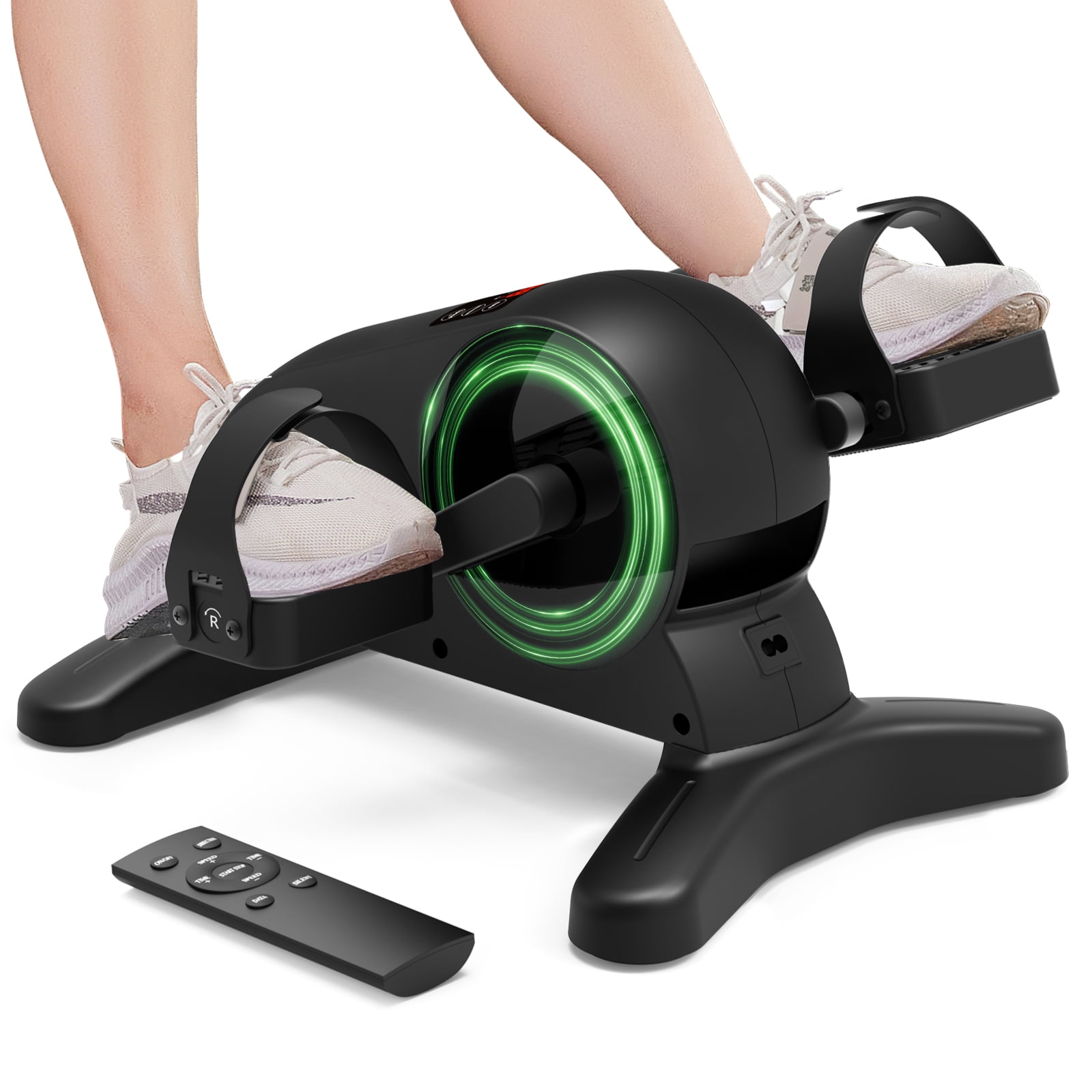
Under-desk pedal exerciser on a carpeted floor in front of a chair
The under-desk pedal exerciser requires zero balance — just sit and pedal.
Tabeke Under-Desk Pedal Exerciser

Ultra-quiet magnetic resistance with 8 levels. No assembly required — unfold and pedal. Also in the Recovery Store.

Check Current Price on Amazon ↗
Sunny Health & Fitness Smart Pedal Exerciser

Bluetooth tracking, adjustable magnetic resistance, and digital display for survivors who want to see progress numerically.

Check Current Price on Amazon ↗

Stage 3: Recumbent bike (3–12 months and beyond)

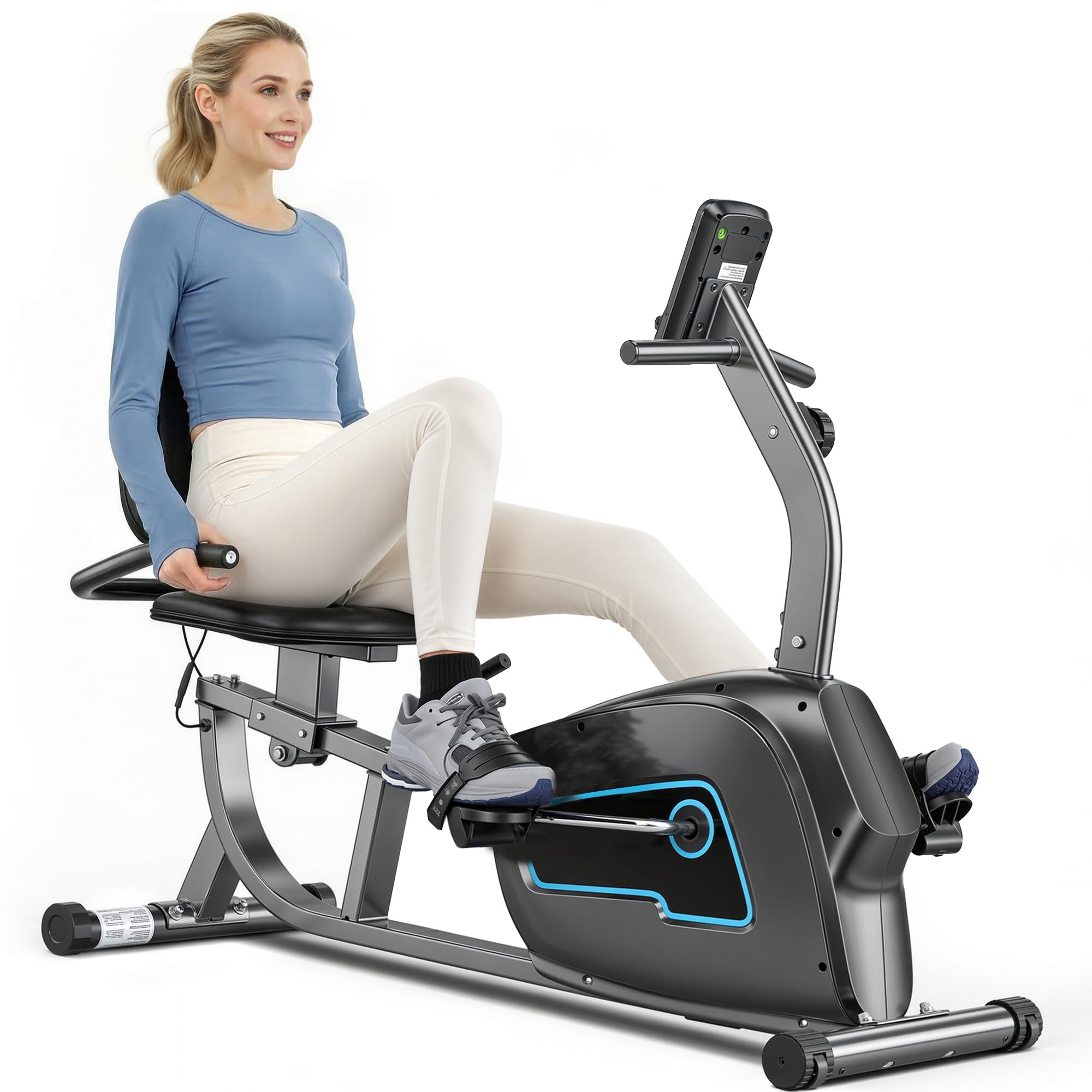
A recumbent bike is the long-term cardio solution for most stroke survivors. The seat has a backrest. The pedals are in front of you, not below you, so hip flexion is minimal. The step-through frame means you walk through the bike to sit down — no lifting the leg over a high bar.

Magnetic resistance provides smooth, joint-friendly loading. Start at the lowest setting and increase by one level every two weeks. A 20-minute session at moderate resistance is a realistic goal by month six for most survivors.

Recumbent exercise bike with step-through frame and padded back support
The recumbent position eliminates the balance and hip-flexion demands of an upright bike.
Marcy Recumbent Exercise Bike

Recumbent bike with supportive seat back, low step-through frame, and adjustable magnetic resistance. Also in the Recovery Store.

Check Current Price on Amazon ↗

How to progress safely

Never increase both duration and resistance in the same week. Pick one variable and hold the other steady. If you add five minutes, keep the resistance the same. If you bump resistance up one level, keep the duration the same. This rule prevents the overuse injuries and fatigue crashes that set survivors back.

Stop immediately if you feel dizziness, chest discomfort, or unusual shortness of breath. These are not "part of the workout" after stroke — they are warning signs that require medical evaluation before continuing.

When to see a doctor

Get clearance before starting any cardio program after stroke. Your neurologist or physiatrist should confirm that blood pressure is controlled, cardiac function is adequate for exertion, and there are no contraindications (such as uncontrolled arrhythmia or recent stent placement).

Seek immediate care if exercise triggers chest pain, severe shortness of breath, fainting, or neurological symptoms (sudden weakness, vision changes, speech difficulty). These are not normal exercise responses after stroke.

Frequently asked questions

Can I use a regular upright stationary bike after stroke?

Most survivors should not start on an upright bike. It requires balance, hip stability, and the ability to lift the affected leg over a high center bar. A recumbent bike or pedal exerciser is safer and more effective in early and mid-recovery.

How long should I pedal per session?

Start at 5–10 minutes for passive or under-desk cycling. Add 1–2 minutes per week. A 20-minute session is a realistic goal by month 3–6. Quality of movement matters more than duration.

Should I pedal with the affected leg only or both legs?

Both legs. Bilateral pedaling reinforces cross-hemispheric coordination and prevents the unaffected side from overcompensating. If the affected leg cannot contribute fully, let the passive motor or the unaffected leg carry the load — the affected leg still receives the sensory input.

Can a pedal exerciser replace physical therapy?

No. A pedal exerciser is a home supplement to structured PT, not a replacement. It builds endurance and reinforces motion patterns that PT teaches. Use it between sessions and on days when PT is not scheduled.

What resistance level should I start at?

Level 1 on any magnetic system. The goal in the first month is motion quality, not workload. If you can pedal smoothly for 10 minutes at level 1 without compensatory trunk sway or breath-holding, you are at the right level.

Marcy Recumbent Exercise Bike

Recumbent bike with supportive seat back, low step-through frame, and adjustable magnetic resistance. The long-term cardio solution for stroke survivors.

Check Current Price on Amazon
Curated by Nick Kremers. As an Amazon Associate, SRA earns from qualifying purchases at no extra cost to you.

The full cardio progression is in the book

THE ULTIMATE STROKE RECOVERY REVOLUTION covers the complete exercise progression — from passive cycling to active resistance — plus the daily routine that keeps gains permanent.

Get the book

Start your recovery free.

Daily routine. AI coach. 66-day challenge. Built by a survivor for survivors.

Create free account