Stair lifts for stroke survivors
At month three, I could barely get up the stairs. By month twelve, I was walking them — but the stair lift was the bridge that kept me independent while I rebuilt. Here is the honest breakdown.
When a stair lift is the right call — and when it is not
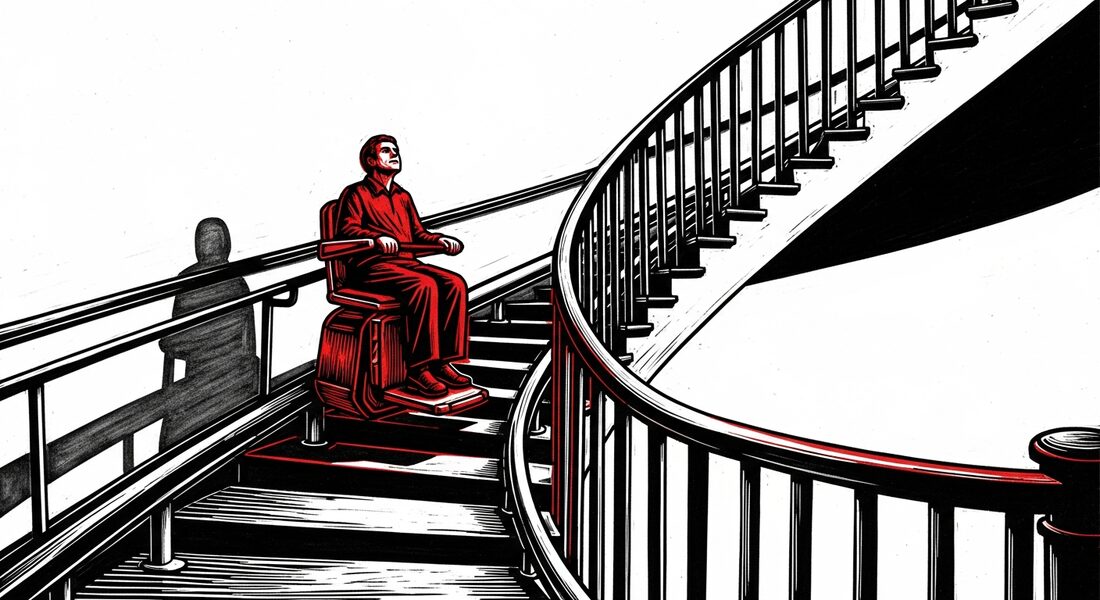
Most stroke survivors can recover stair-climbing with therapy and practice. The stair lift is not a permanent decision — it is a temporary bridge. The question is not "will I ever walk stairs again?" The question is "can I safely walk stairs today while I rebuild?" If the answer is no, the stair lift is the right investment.
The stair lift is independence, not surrender. It means you sleep in your own bed upstairs instead of the couch. It means you use the upstairs bathroom instead of a bedside commode. It means you do not need a caregiver to carry you. The stair lift buys you time to recover — and time is the only thing stroke recovery demands.
AmeriGlide Rave 2 — the $1,500 option that works for straight stairs
The AmeriGlide Rave 2 is a straight-rail stair lift designed for standard staircases. It runs on a 12-volt DC motor, folds flat when not in use, and has a 300-lb capacity. The seat swivels for safe entry and exit at the top landing — a critical feature for stroke survivors who need to pivot from sitting to standing at the top of the stairs.
The price is $1,499 on Amazon — the lowest entry point for a legitimate stair lift. Installation is two to four hours for a straight staircase. The Rave 2 does not work on curved stairs or spiral staircases — for those, you need a custom-rail system.
- Straight-rail design — works on most standard staircases
- 300-lb capacity — accommodates most survivors plus a caregiver
- Swivel seat — safe entry and exit at the top landing
- Folds flat — 12-inch profile when not in use
- 12V DC motor — quiet, battery-backed for power outages
Straight-rail stair lift with 300-lb capacity, swivel seat, and battery backup. The most affordable legitimate stair lift for stroke survivors.
Check Current Price on Amazon ↗The real cost — and what insurance covers
Standard Medicare (Parts A and B) does not cover stair lifts. They classify stair lifts as "home modification" rather than "durable medical equipment." Some Medicare Advantage plans and Medicaid waiver programs offer limited coverage — check your plan. Private insurance varies by carrier. The most reliable path is a written evaluation from your occupational therapist that documents the medical necessity of the stair lift for safe home access.
The out-of-pocket cost for a straight-rail stair lift is $1,500–$3,000 installed. For a curved-rail system, $3,000–$8,000. The resale value is low — stair lifts are custom-fit to the staircase. The right way to think about the cost is not as a purchase but as an investment in independence during the recovery window.
| Type | Price range | Best for | Key feature | Install time |
|---|---|---|---|---|
| Stannah Starla | $1,500–$2,500 | Straight staircase, budget | Compact rail, slim profile | 2–4 hours |
| Bruno Elite | $2,500–$3,500 | Straight staircase, premium | Smooth start/stop, 400 lb cap | 2–4 hours |
| Harmar Pinnacle SL600 | $3,000–$4,000 | Curved staircase, modular | Custom rail, outdoor option | 4–8 hours |
| Acorn 180 | $3,500–$5,000 | Curved staircase, budget | Tight turn radius, 2-year warranty | 4–8 hours |
How long to keep the stair lift — and when to remove it
I kept my stair lift for 18 months. At month 12, I could walk the stairs with a handrail. At month 15, I could walk the stairs without a handrail on the good side. At month 18, I removed the lift. The resale market is active — stair lifts are in demand, and the used market is strong. I sold mine for 40% of the purchase price.
The stair lift is not a forever decision. It is a temporary bridge. Plan for 12–24 months of use. Budget for removal and resale. And train stair-climbing in parallel — the stair lift keeps you safe today, but the goal is to walk the stairs again tomorrow.
Frequently asked questions
Does Medicare cover stair lifts for stroke survivors?
Standard Medicare does not cover stair lifts. Some Medicare Advantage plans and Medicaid waiver programs offer limited coverage. The best path is an OT evaluation documenting medical necessity. Many stair lift companies offer payment plans.
How long do stroke survivors typically need a stair lift?
Most survivors use a stair lift for 12–24 months while rebuilding stair-climbing strength and balance. The goal is to remove it when stairs are safe again — not to keep it permanently.
Can a stair lift be installed on a curved staircase?
Yes — but it requires a custom-curved rail, which is more expensive ($3,000–$8,000) and takes 4–6 weeks to fabricate. The Bruno Elan is the standard for curved staircases. Straight-rail lifts like the AmeriGlide Rave 2 only work on standard straight staircases.
Is a stair lift safe for stroke survivors with one-sided weakness?
Yes — the swivel seat and powered footrest make entry and exit manageable with one-sided weakness. The safety belt and obstruction sensor prevent the lift from moving if the seat is not properly positioned. Always have a caregiver or PT supervise the first uses until the survivor is confident with the entry and exit motion.
Can I remove a stair lift and sell it later?
Yes — the used stair lift market is active. Expect 30–50% of the purchase price for a used straight-rail lift in good condition. The rail is the limiting factor — it is custom-cut to the staircase, so the next buyer needs the same or similar stair dimensions.
What is the cheapest stair lift for stroke survivors?
The AmeriGlide Rave 2 at $1,499 is the cheapest legitimate straight-rail stair lift. The Stannah Starla at $1,500 is the cheapest premium option. Do not buy a used stair lift without a professional inspection — the motor, battery, and rail condition matter. A $500 used lift with a dead motor is not a deal.
How do I choose between a stair lift and a wheelchair ramp?
The stair lift is for the staircase. The ramp is for the threshold and the porch. If your house has a single-level main floor and stairs only to the basement or second floor, the stair lift is the right choice. If the front door has a step or the porch is elevated, add a threshold ramp. The two are not alternatives — they are complementary. Most survivors with a stair lift also need a ramp at the front door.
Does a stair lift block the stairs for other people?
The AmeriGlide Rave 2 rail is 6 inches from the wall — enough room for a person to walk beside it. The seat folds up against the wall when not in use, so the stair is not blocked. The Bruno Elan seat is even more compact. The only limitation is that two people cannot walk side-by-side on the stair while the lift is installed — one must walk in front of the other.
Can a stroke survivor use a stair lift without a caregiver?
Yes — after the initial training period. The first 10 uses should be supervised by a caregiver or PT to ensure the survivor is confident with the entry, the seatbelt, and the exit. After that, most survivors operate the lift independently. The remote control is the backup — if the survivor cannot reach the armrest control, the caregiver can call the lift from the top or bottom of the stairs.
What is the weight limit for stair lifts after stroke?
Most standard stair lifts support 300–350 pounds. The Bruno Elan supports 400 pounds. The AmeriGlide Rave 2 supports 300 pounds. The Harmar Pinnacle SL600 supports 350 pounds. If the survivor is over 300 pounds, confirm the capacity before ordering. The seat width and depth also matter — a 20-inch seat is standard, but wider seats are available.
AmeriGlide Rave 2 — the stair lift that buys you time
Straight-rail stair lift with 300-lb capacity, swivel seat, battery backup. The most affordable legitimate stair lift for stroke survivors at $1,499.
Check price on AmazonHome independence in the book
THE ULTIMATE STROKE RECOVERY REVOLUTION covers the home environment, fall prevention, the stair lift decision, and the daily routine that builds the strength to walk stairs again.
Get the bookStart your recovery free.
Daily routine. AI coach. 66-day challenge. Built by a survivor for survivors.
Create free account