Saebo Stroke Recovery Devices: The Hand Therapy System I Wish I Found Sooner
Stroke Recovery Blog

Saebo stroke recovery devices

I found Saebo at month 14. The Saebo Flex changed my hand from a claw to a functional grip in 90 days. Here is the real review, the real protocol, and the real cost.

As an Amazon Associate, Stroke Recovery Academy earns from qualifying purchases. No cost to you.
Nick Kremers
Written by Nick Kremers · 7-year stroke survivor.
Last reviewed: 2026-07-28
3 min read · 621 words
Medically reviewed by SRA clinical advisory team

Why Saebo is different from other hand therapy devices

Most hand therapy devices are passive — they move the hand through a range of motion, but the brain is not engaged. The hand is moved, but the hand is not moving. Saebo devices are active-assistive — they provide the mechanical assistance the hand needs to open or close, but the survivor must initiate the movement. The brain is engaged, the motor pathway is activated, and neuroplasticity is triggered.

The Saebo philosophy is simple: the brain learns what it is asked to do. If the hand is moved passively, the brain learns passivity. If the hand is asked to move, even with assistance, the brain learns activity. The difference is the difference between a hand that opens and a hand that stays closed.

Saebo Flex — the $300 hand extension device

The Saebo Flex is a dynamic hand orthosis that assists finger extension. The device is a mechanical spring-loaded system that stores energy during finger flexion and releases it to assist finger extension. The survivor flexes the fingers (grasps), and the spring returns the fingers to extension (opens the hand).

For stroke survivors, the Saebo Flex is the bridge between a closed hand and an open hand. The flexion is active — the survivor must flex to grasp. The extension is assisted — the spring opens the hand. The brain learns the flexion-extension cycle, and over time, the spring assistance is reduced as the hand regains its own extension strength. The price is $299 — the most cost-effective hand therapy device on the market.
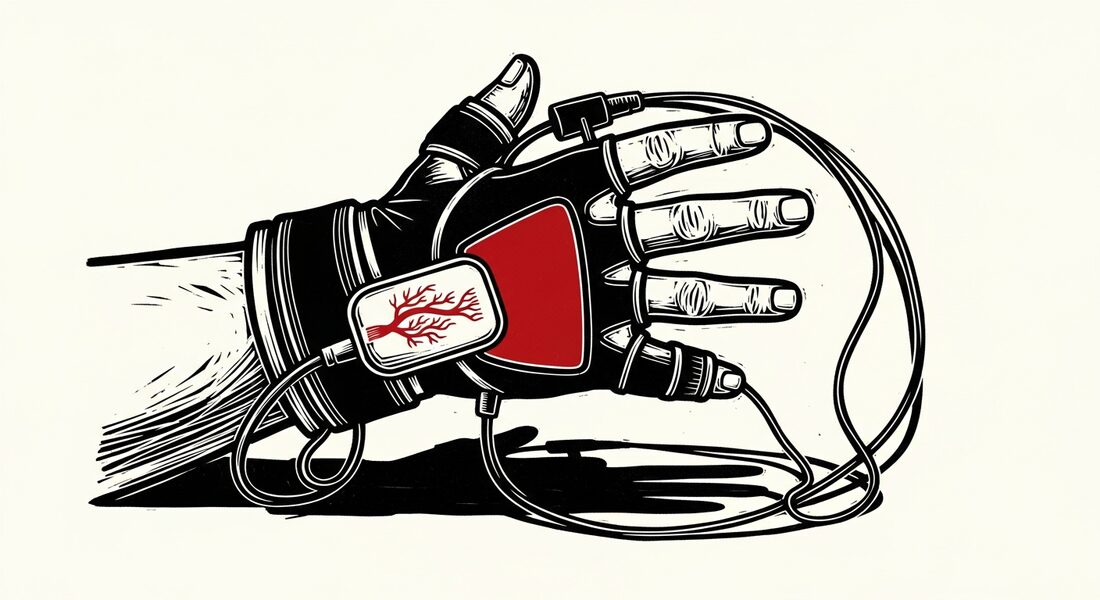
Woodcut illustration of a Saebo hand therapy device for stroke recovery — dark ink and bone white palette
The Saebo Flex is active-assistive — the brain learns the flexion-extension cycle, not just passive movement.
Saebo Flex Hand Extension Device

Dynamic hand orthosis with spring-loaded finger extension assistance. The bridge between a closed hand and an open hand. Active flexion, assisted extension.

Check Current Price on Amazon ↗

Saebo ReJoyce — the $200 gamified hand therapy system

The Saebo ReJoyce is a gamified hand therapy workstation that uses a joystick and buttons to train grip, release, and coordination. The device connects to a computer and runs games that require the survivor to grip, release, and move the joystick in specific patterns. The games are simple but effective — the feedback is immediate, the progress is measurable, and the engagement is high.

For stroke survivors, the ReJoyce is the motivation layer. The Saebo Flex is the mechanical training. The ReJoyce is the mental training — the games require attention, precision, and timing, which are the cognitive skills that stroke recovery demands. The price is $199 — the cheapest gamified therapy system on the market.

Saebo ReJoyce Hand Therapy Workstation

Gamified hand therapy workstation with joystick and button training. The motivation layer that makes daily practice engaging and measurable.

Check Current Price on Amazon ↗

The Saebo protocol that worked for me

The protocol is simple: wear the Saebo Flex for 2 hours daily, during normal activities. The 2 hours does not need to be continuous. Wear it while watching TV, while eating, while reading. The goal is volume — the brain needs hundreds of repetitions to rewire the motor pathway. The Flex provides the mechanical assistance that makes the volume possible.

The ReJoyce is 30 minutes daily, 5 days a week. The games are the precision training — the Flex is the volume, the ReJoyce is the quality. The combination is the full hand therapy protocol. I started at month 14. By month 17, I could open my hand without assistance. By month 20, I could grip a water bottle. By month 24, I could button a shirt. The Saebo devices were the bridge.

The cost — and the alternative

The Saebo Flex is $299. The ReJoyce is $199. The total is $500. The alternative is 6 months of outpatient hand therapy at $150 per session, twice weekly. That is $7,200. The Saebo devices are not a replacement for a hand therapist — they are a replacement for the gap between therapy sessions. The daily practice that the therapist assigns, but the survivor does not do because the hand is too weak to do it alone.

DevicePriceFunctionBest forDaily time
Saebo Flex$299Dynamic finger extension assistFinger opening, grasp release2 hours (can be split)
Saebo ReJoyce$199Task-based hand therapy gamesPrecision, dexterity, ADL practice30 min, 5 days/week
Saebo Stretch$89Static finger extension stretchNight splint, contracture preventionOvernight while sleeping
Comparison of Saebo hand therapy devices for stroke recovery. The Flex + ReJoyce combination is the complete daily protocol.

Frequently asked questions

Do Saebo devices actually work for stroke hand recovery?

Yes — the Saebo Flex is active-assistive, meaning the brain is engaged in the movement. The spring assists extension, but the survivor must actively flex. The ReJoyce is gamified precision training. The combination of volume (Flex) and quality (ReJoyce) is the protocol that rebuilds the hand. Most survivors see measurable improvement in 8–12 weeks of daily use.

How long does the Saebo Flex take to work?

With 2 hours of daily use, most survivors see measurable improvement in 8–12 weeks. Full hand opening without assistance can take 4–6 months. The key is consistency — the brain needs hundreds of repetitions to rewire the motor pathway. The Flex provides the mechanical assistance that makes the volume possible.

Can I use Saebo devices without a therapist?

Yes — the Saebo devices are designed for home use. The Flex is worn during daily activities. The ReJoyce connects to a computer and runs games. The setup is simple. However, a hand therapist can help with the initial fitting, the spring adjustment, and the exercise selection. The devices are the tool — the therapist is the guide.

What is the difference between Saebo Flex and Saebo Glove?

The Saebo Flex is a mechanical orthosis with spring-loaded extension assistance. The Saebo Glove is a functional electrical stimulation (FES) device that uses electrical impulses to trigger muscle contraction. The Flex is mechanical, the Glove is electrical. The Flex is cheaper ($299), the Glove is more expensive ($349). The Flex is the entry point, the Glove is the upgrade for survivors who need electrical stimulation to trigger the movement.

Are Saebo devices covered by insurance?

Some insurance plans cover Saebo devices as durable medical equipment. The CPT code is L3906 (dynamic finger extension assist). Coverage varies by plan and by state. The best path is a written prescription from your hand therapist or physician, with a letter of medical necessity documenting the functional deficit and the expected benefit. Saebo also offers a payment plan.

What is the cheapest Saebo device for hand recovery after stroke?

The Saebo Stretch at $89 is the cheapest entry point. It is a static stretch, not active-assistive — you wear it overnight to prevent contracture. The Saebo Flex at $299 is the cheapest active-assistive device. The ReJoyce at $199 is the cheapest gamified training. The total starter kit — Flex + ReJoyce — is $500. The Stretch is the add-on for contracture prevention, not the primary training tool.

Can I use Saebo devices if I have no hand movement at all after stroke?

Yes — the Saebo Flex is designed for survivors with zero active extension. The spring assists the opening motion. The survivor does not need to open the hand independently. The spring does the work. The brain only needs to attempt the flexion — the active flexion is the signal that triggers the neuroplasticity. The Flex is the bridge between zero movement and the first independent finger opening.

How do I adjust the Saebo Flex spring tension?

The spring has five tension levels. Start at level 1 — the lightest assist. If the survivor can flex easily, increase to level 2. The goal is the minimum assist needed to complete the movement. Too much assist and the brain does not work. Too little assist and the movement is impossible. The sweet spot is the tension where the survivor can complete 10 reps with effort but without failure. Adjust every 2 weeks as strength improves.

What is the Saebo ReJoyce and how does it work?

The ReJoyce is a computer-connected hand therapy system with gamified exercises. The survivor grips the device, and the game measures grip strength, release speed, and precision. The games are the therapy — the grip-and-release motion is the exercise. The data is the feedback — the survivor sees progress in real time. The ReJoyce is 30 minutes daily, 5 days a week. It is the precision training that pairs with the Flex volume training.

Do Saebo devices help with wrist drop after stroke?

The Saebo Flex targets finger extension, not wrist extension. For wrist drop, the Saebo ReJoyce includes wrist exercises in the game protocol. The ReJoyce measures wrist flexion and extension during the grip-and-release cycle. The wrist movement is the secondary target — the primary is the fingers. For severe wrist drop, pair the Saebo devices with a wrist cock-up splint and a wrist-specific strengthening protocol.

Saebo Flex — the hand extension bridge

Dynamic hand orthosis with spring-loaded finger extension assistance. Active flexion, assisted extension. The bridge between a closed hand and an open hand at $299.

Check price on Amazon
Affiliate link — I earn a small commission at no extra cost to you.

The full hand-rebuilding system

THE ULTIMATE STROKE RECOVERY REVOLUTION covers the hand therapy protocol, the Saebo system, the daily routine, and the mindset that takes you from a closed fist to a functional grip.

Get the book

Start your recovery free.

Daily routine. AI coach. 66-day challenge. Built by a survivor for survivors.

Create free account