5 Supplements I Took During Stroke Recovery — And the One I Wish I Started Earlier
Stroke Recovery Blog

Supplements for stroke recovery

I spent $30 a month on supplements. The Omega-3 was the one that mattered most. Here is the exact stack, the exact dosage, and the evidence that backs it.

As an Amazon Associate, Stroke Recovery Academy earns from qualifying purchases. No cost to you.
Nick Kremers
Written by Nick Kremers · 7-year stroke survivor.
Last reviewed: 2026-07-28
4 min read · 756 words
Medically reviewed by SRA clinical advisory team

The supplement reality after stroke

Supplements are not a replacement for therapy, medication, or hard work. They are a support layer — the biochemical foundation that makes the other layers work better. The brain is 60% fat. The cell membranes are made of phospholipids. The neurotransmitters are built from amino acids. The mitochondria need coenzymes. If the raw materials are deficient, the brain cannot rebuild optimally.

The supplement industry is a wasteland of marketing and pseudoscience. Most supplements are expensive urine. The five below are the ones with real evidence, real dosing, and real effects — and I took them daily for seven years.

Omega-3 (EPA/DHA) — the neuroinflammation reducer

Omega-3 fatty acids — specifically EPA and DHA — are the single most evidence-backed supplement for stroke recovery. EPA reduces neuroinflammation. DHA rebuilds cell membranes. The brain is 60% fat, and DHA is the primary structural fat in the brain. After stroke, the inflammatory cascade damages cell membranes. Omega-3 is the raw material to rebuild them.

The dosage that matters: 2,000–4,000 mg of combined EPA+DHA daily. The ratio should be 2:1 EPA to DHA. The form matters — triglyceride form is better absorbed than ethyl ester form. I use Nordic Naturals ProOmega 2000, which delivers 2,000 mg of EPA+DHA in two softgels. The cost is $35–$45 per month.

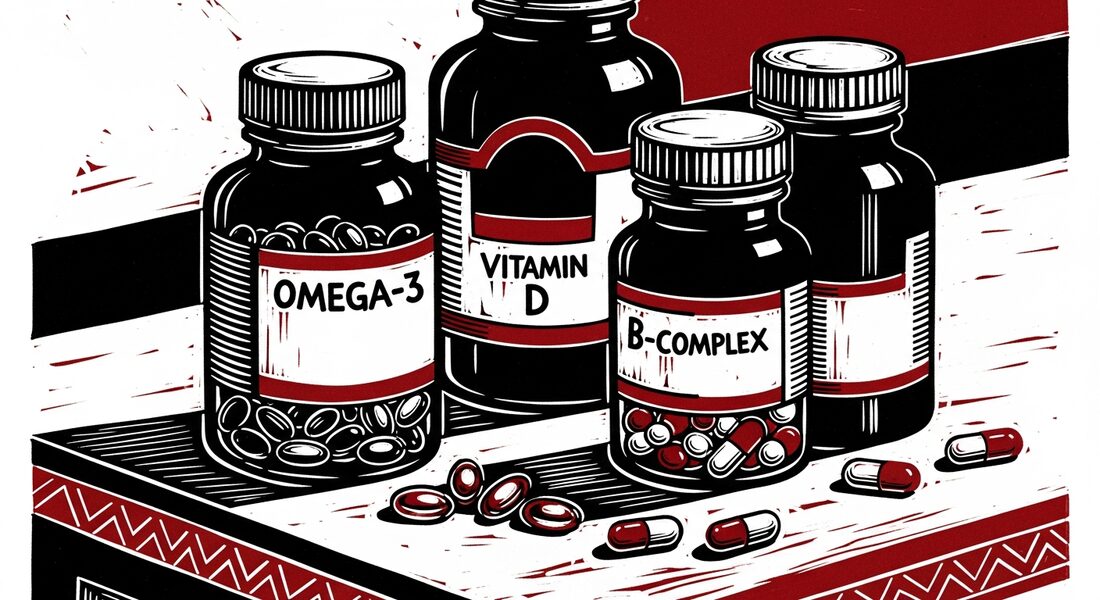
Woodcut illustration of supplement bottles for stroke recovery — dark ink and bone white palette
Omega-3 is the single most evidence-backed supplement for stroke recovery — 2,000mg EPA+DHA daily.
Nordic Naturals ProOmega 2000

2,000 mg EPA+DHA per serving, triglyceride form, IFOS certified. The most evidence-backed supplement for stroke recovery. Two softgels daily.

Check Current Price on Amazon ↗

Vitamin D3 + K2 — the bone and mood stack

Vitamin D deficiency is common after stroke — reduced mobility means less sun exposure, and many survivors are housebound in the first year. Vitamin D is not just for bones. It is a neurosteroid that modulates immune function, mood, and neuroplasticity. The evidence for vitamin D in stroke recovery is strong for bone health and moderate for mood and cognitive function.

Vitamin K2 is the cofactor that directs calcium to bone instead of arteries. D3 without K2 can deposit calcium in the arteries, which is the last thing a stroke survivor needs. The dosage: 2,000–5,000 IU D3 daily, with 100–200 mcg K2 (MK-7 form). I use Thorne D-5000, which delivers 5,000 IU D3 with K2. The cost is $15–$20 per month.

Thorne Vitamin D-5000 with K2

5,000 IU D3 + K2 (MK-7) in one capsule. The bone and mood stack for stroke survivors. Third-party tested by NSF.

Check Current Price on Amazon ↗

B-Complex (methylated) — the nerve repair and energy stack

The B vitamins are the cofactors for neurotransmitter synthesis, nerve myelination, and energy metabolism. B1 (thiamine) is critical for nerve conduction. B6 (pyridoxine) is the cofactor for dopamine and serotonin synthesis. B12 (cobalamin) is essential for nerve myelination. Folate is the cofactor for DNA repair and neurotransmitter synthesis.

The "methylated" form matters. Many stroke survivors have MTHFR gene variants that impair the conversion of synthetic folic acid and B12 to their active forms. Methylated forms bypass this conversion — methylfolate instead of folic acid, methylcobalamin instead of cyanocobalamin. The dosage: a high-quality B-complex with 800 mcg methylfolate, 1,000 mcg methylcobalamin, and 50 mg B6. I use Jarrow Methyl B-12 / Methyl Folate. The cost is $15–$25 per month.

Jarrow Formulas Methyl B-12 / Methyl Folate

Methylcobalamin B-12 + methylfolate in lozenge form. Methylated forms bypass MTHFR gene variants. Critical for nerve repair and energy metabolism.

Check Current Price on Amazon ↗

CoQ10 (ubiquinol) — the mitochondrial support

CoQ10 is the electron carrier in the mitochondrial electron transport chain — the process that generates ATP, the energy currency of the cell. Stroke damages mitochondria, and the brain is the most energy-hungry organ in the body. CoQ10 supports mitochondrial function, reduces oxidative stress, and improves energy production.

The form matters — ubiquinol is the reduced, active form. Ubiquinone is the oxidized form that the body must convert. After stroke, the conversion capacity may be impaired, so ubiquinol is the better choice. The dosage: 100–200 mg ubiquinol daily. I use Doctor's Best Ubiquinol with Kaneka. The cost is $25–$35 per month.

Doctor's Best Ubiquinol with Kaneka

100 mg ubiquinol (reduced, active form) per softgel. Supports mitochondrial function and ATP production in the energy-hungry post-stroke brain.

Check Current Price on Amazon ↗

Magnesium glycinate — the spasticity and sleep mineral

Magnesium is the mineral that relaxes muscles and calms the nervous system. It is the natural antagonist to calcium — calcium contracts muscles, magnesium relaxes them. After stroke, magnesium deficiency is common due to reduced dietary intake, medication interactions, and increased stress.

The form matters — magnesium glycinate is the most bioavailable and least laxative form. Magnesium oxide is cheap but poorly absorbed. Magnesium citrate is well absorbed but can cause diarrhea. The dosage: 200–400 mg elemental magnesium daily, taken in the evening for sleep benefit. I use Pure Encapsulations Magnesium Glycinate. The cost is $15–$20 per month.

Pure Encapsulations Magnesium Glycinate

120 mg elemental magnesium per capsule, glycinate form for maximum absorption and minimal GI side effects. Take 2–3 in the evening for muscle relaxation and sleep.

Check Current Price on Amazon ↗

The one supplement I wish I started earlier

Omega-3. I started it at month six, but I should have started it at week two. The neuroinflammation after stroke is most acute in the first month, and that is when the brain needs the DHA and EPA the most. The delay cost me weeks of recovery. If you are reading this in the first month, start Omega-3 today. The evidence is overwhelming. The cost is negligible. The upside is enormous.

SupplementDoseKey benefitCost/monthStart time
Omega-3 (Nordic Naturals)2,000 mg EPA+DHANeuroinflammation, membrane repair$25Week 2 post-stroke
Magnesium Glycinate (Pure Encapsulations)240–360 mg elementalMuscle relaxation, sleep, spasticity$18Month 1
B-Complex (Jarrow Methyl B-12)1,000 mcg B-12, 50 mg B-6Nerve conduction, energy metabolism$12Month 1
CoQ10 (Doctor's Best)200 mg ubiquinolMitochondrial energy, neuroprotection$20Month 3
Core supplement stack for stroke recovery. Doses are standard adult recommendations; consult your doctor before starting.

Frequently asked questions

Do supplements actually help stroke recovery?

Yes — but they are a support layer, not a primary intervention. Omega-3 (EPA/DHA) has the strongest evidence for neuroinflammation reduction. Vitamin D3 + K2 supports bone health and mood. B-complex supports nerve repair and energy. CoQ10 supports mitochondrial function. Magnesium supports muscle relaxation and sleep. None replace therapy, medication, or hard work. All improve the biochemical foundation that makes the other layers work better.

What is the best Omega-3 for stroke recovery?

Nordic Naturals ProOmega 2000 is the standard — 2,000 mg EPA+DHA per serving, triglyceride form for better absorption, IFOS certified for purity. The dosage is 2,000–4,000 mg combined EPA+DHA daily. The ratio should be 2:1 EPA to DHA. Start as early as possible — the first month is the most critical window for neuroinflammation management.

Can I take supplements with stroke medication?

Most supplements are safe with common stroke medications, but interactions exist. Omega-3 can increase bleeding risk with blood thinners — monitor with your physician. Vitamin K2 can interfere with warfarin — avoid K2 if on warfarin. B-complex is generally safe. CoQ10 can interact with statins — discuss with your physician. Magnesium is generally safe. Always review supplements with your physician or pharmacist.

How much do supplements cost per month for stroke recovery?

The full stack — Omega-3, vitamin D3+K2, B-complex, CoQ10, and magnesium — costs $90–$120 per month. The minimum effective stack — Omega-3 and vitamin D3+K2 — costs $50–$65 per month. The entry point — just Omega-3 — costs $35–$45 per month. Start with Omega-3 and add the others as budget allows.

Are generic supplements as good as name brands for stroke recovery?

Not always. The supplement industry is unregulated, and quality varies widely. Look for third-party certification — IFOS for Omega-3, NSF or USP for vitamins, and CGMP manufacturing. The brands I recommend — Nordic Naturals, Thorne, Jarrow, Doctor's Best, Pure Encapsulations — all have third-party testing and transparent sourcing. Generic supplements may have the same label claim but different bioavailability and purity.

When should I start taking supplements after stroke?

Omega-3 should start at week 2 — the neuroinflammation window is most acute in the first month. Vitamin D3+K2 and B-complex should start at month 1. Magnesium should start when spasticity or sleep issues appear — usually month 1–3. CoQ10 should start at month 3 when the energy deficit becomes the limiting factor. The timing is not arbitrary — it matches the biological recovery timeline.

Can supplements prevent a second stroke?

Omega-3 and vitamin D3 have evidence for cardiovascular risk reduction, but they are not substitutes for medical prevention. Blood pressure control, statin therapy, anticoagulation (if indicated), and lifestyle change are the primary prevention tools. Supplements are the secondary layer — they support the cardiovascular system but do not replace the medical protocol. The best prevention is the combination of medical care, supplements, and lifestyle.

What supplements should I avoid after stroke?

Avoid vitamin K2 if you are on warfarin — it interferes with the anticoagulant effect. Avoid high-dose vitamin E — it can increase bleeding risk. Avoid St. John's Wort — it interacts with many medications including antidepressants and blood thinners. Avoid ginkgo biloba — it increases bleeding risk. Avoid miracle supplements that claim to "reverse stroke damage" with no clinical trial. The supplement industry is full of false promises. Stick to the evidence-backed stack.

How do I know if supplements are working for my stroke recovery?

Track the metrics. For Omega-3: reduced inflammation markers (CRP, if tested), improved mood, better sleep. For vitamin D3: improved mood, reduced fatigue, better bone density (DEXA scan). For B-complex: improved energy, reduced neuropathy. For magnesium: reduced spasticity, better sleep. For CoQ10: improved energy, reduced fatigue. The effects are subtle and cumulative — give each supplement 6–8 weeks before evaluating. Track in a journal or the app.

Can I get all the nutrients I need from food after stroke?

In theory, yes. In practice, no. The post-stroke diet is often limited by swallowing difficulty, reduced appetite, medication side effects, and fatigue. The Omega-3 requirement alone — 2,000–4,000 mg EPA+DHA daily — would require eating 1–2 pounds of fatty fish every day. The vitamin D3 requirement — 2,000–5,000 IU daily — would require hours of sun exposure. The B-complex requirement — high-dose B-12 and B-6 — would require eating organ meats daily. Supplements fill the gap between what you need and what you can eat.
Nordic Naturals ProOmega 2000 — the Omega-3 standard

2,000 mg EPA+DHA per serving, triglyceride form, IFOS certified. The single most evidence-backed supplement for stroke recovery. Start at week two, not month six.

Check price on Amazon
Affiliate link — I earn a small commission at no extra cost to you.

The full nutrition and supplement system

THE ULTIMATE STROKE RECOVERY REVOLUTION covers the full supplement stack, the dietary protocol, the hydration strategy, and the timing that makes each layer work together.

Get the book

Start your recovery free.

Daily routine. AI coach. 66-day challenge. Built by a survivor for survivors.

Create free account