Best home gym stations for stroke recovery
After my stroke at 36, I had one good side and one weak side. A commercial gym is intimidating. A home gym is the only way to train daily. Here is what I used — and what I would buy today at every budget.
Why a home gym is non-negotiable after stroke
Commercial gyms are built for people with two working sides. The machines assume bilateral strength. The free-weight floor assumes grip and balance. After stroke, the gap between what a gym expects and what your body delivers is wide enough to make you quit — and quitting is the one thing that kills recovery.
A home gym eliminates the commute, the social pressure, the operating-hour constraint, and the equipment mismatch. You train when you want, how you want, with equipment that fits your current level. The daily habit is the whole game — and the home gym is the only way to make daily training practical long-term.
Total Gym XLS — the $750 entry point that actually works
The Total Gym XLS is a bodyweight resistance system on an adjustable incline. You lie, sit, or kneel on a glideboard and pull cables against your own bodyweight. The resistance changes by adjusting the incline angle — lower angle means less resistance, higher angle means more.
For stroke survivors, the Total Gym is the safest first gym. The glideboard supports your body so balance is not a constraint. You can train the affected side in isolation while the board stabilizes the trunk. The seated row, chest press, and leg pull work the full body without standing. The price — $750 — is the lowest entry point for a legitimate full-body station.
- Bodyweight resistance — no weights to drop, no plates to load
- Glideboard support — train without standing balance
- Adjustable incline — resistance from 10% to 60% of bodyweight
- 400 lb capacity — works for most survivors plus a caregiver spotting
- Folds for storage — fits in a closet when not in use
Bodyweight resistance system with glideboard. The safest entry-level home gym for stroke survivors — seated, supported, full-body training without balance demands.
Check Current Price on Amazon ↗Bowflex Revolution — the $2,300 station that scales with you
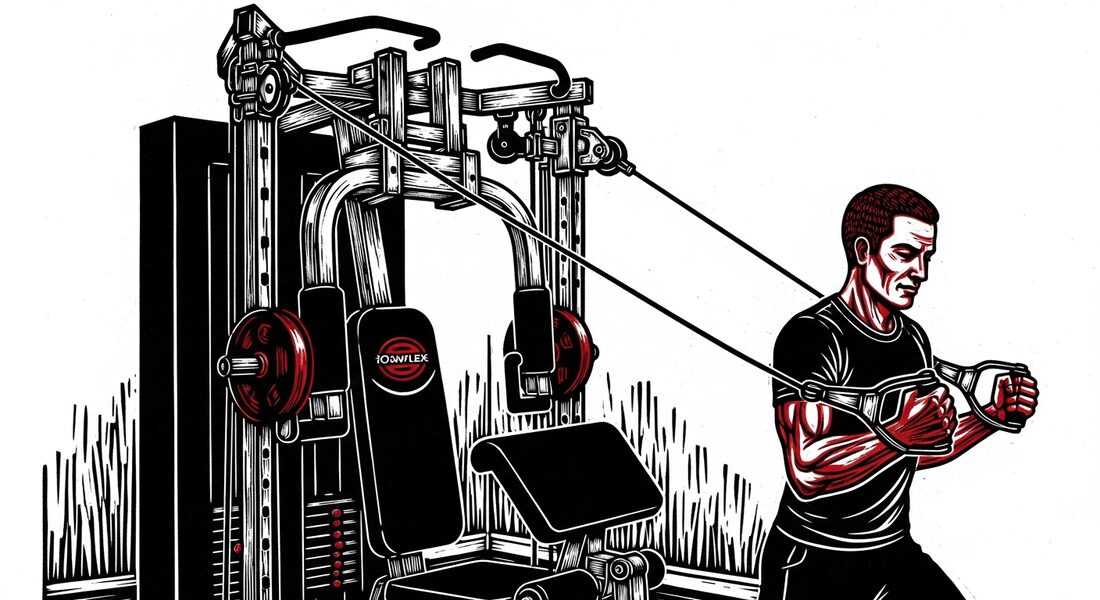
The Bowflex Revolution uses Spiraflex resistance — a patented technology that delivers constant tension through a full range of motion, without the inertia of free weights. The resistance is smooth, predictable, and adjustable from 10 to 300 lbs per arm. The independent arm movement means each side works independently — critical for stroke survivors with asymmetric strength.
The bench converts to a seated position for upper-body work, and the leg press station handles lower-body without standing. The footprint is 84 x 38 inches — a compact footprint for a full gym. The price is $2,299 on sale, which is expensive — but it replaces a gym membership, a trainer, and the commute. For survivors who are serious about the long game, the Bowflex Revolution is the station that grows with you from month 6 to year 5.
- Spiraflex resistance — constant tension, no inertia, no dropped weights
- Independent arm movement — train the affected side without the strong side compensating
- 300 lbs per arm — enough resistance to challenge even late-recovery survivors
- Leg press station included — lower-body training without standing
- Compact footprint — fits in a standard bedroom or garage bay
Spiraflex resistance system with independent arm movement. The home gym that scales from early recovery to year 5. Currently on sale at $2,299.
Check Current Price on Amazon ↗Body-Solid EXM3000LPS — the commercial-grade station at $1,500
The Body-Solid EXM3000LPS is a three-station multi-gym with dual weight stacks — two people can train simultaneously, or one survivor can alternate between stations without restacking plates. The weight stacks are selectorized — pull a pin, the resistance changes. No plates to load, no collars to tighten.
For stroke survivors, the EXM3000LPS works because the weight stacks are cable-based. Cables force the muscle to control the motion in both directions — concentric and eccentric — which is exactly the neuroplasticity training principle that stroke recovery requires. The three stations cover chest press, lat pulldown, and leg press, with enough range to work the full body. At $1,500, it is the most gym-for-the-money on this list.
- Three stations — chest press, lat pulldown, leg press in one footprint
- Dual 210-lb weight stacks — selectorized, no plate loading
- Cable-based resistance — full range eccentric and concentric control
- Lifetime warranty on everything — frame, pads, cables, pulleys
Three-station multi-gym with dual 210-lb selectorized stacks. Cable-based resistance for full neuroplasticity training. Best gym-for-the-money on the list.
Check Current Price on Amazon ↗Life Fitness G4 — the commercial-grade investment at $3,900
The Life Fitness G4 is a single-station functional trainer with dual adjustable pulleys, a pull-up bar, and a bench press station. The pulleys adjust from high to low in 19 positions, allowing you to train every angle — overhead press, seated row, bicep curl, tricep pushdown, chest fly, and more. The resistance is magnetic, smooth, and silent.
For stroke survivors, the G4 is the most versatile station on this list. The adjustable pulleys let you train the affected side at the exact angle that is weakest — overhead for deltoids, mid-height for rows, low for leg extensions. The magnetic resistance is consistent, so every rep feels the same, which is critical for motor learning. The price is $3,899 — the highest on this list — but the quality is commercial-grade, and the versatility means you will not outgrow it.
Dual adjustable pulley functional trainer with magnetic resistance. The most versatile station for stroke recovery — train every angle at every strength level.
Check Current Price on Amazon ↗The budget I recommend — and what to skip
If you are month 1–6 post-stroke, start with the Total Gym XLS at $750. The supported glideboard makes it safe to train without balance, and the resistance range is enough for the first year. Upgrade to the Bowflex Revolution or Body-Solid when you need more resistance and independence.
If you are month 6–24 and training daily, the Bowflex Revolution at $2,299 is the best long-term investment. The independent arm movement is the key feature for asymmetric strength — your strong side cannot compensate for the weak side. The Spiraflex resistance is smooth, predictable, and joint-friendly.
If you are year 2+ and want a gym that does not limit you, the Life Fitness G4 at $3,900 is the last gym you will buy. The versatility is unmatched — every angle, every muscle, every progression.
| Station | Price | Best for | Key feature | Space needed |
|---|---|---|---|---|
| Total Gym XLS | $750 | Month 1–6, balance deficits | Glideboard support | Fits in closet |
| Bowflex Revolution | $2,299 | Month 6–24, daily training | Independent arm movement | 84 x 38 in |
| Body-Solid EXM3000LPS | $1,500 | Best value, neuroplasticity | Cable-based resistance | 9 x 7 ft |
| Life Fitness G4 | $3,900 | Year 2+, maximum versatility | Dual adjustable pulleys | 8 x 6 ft |
Frequently asked questions
Can I use a home gym with one-sided weakness after stroke?
Yes — and you should. The Total Gym XLS supports your body on a glideboard, so balance is not a constraint. The Bowflex Revolution has independent arm movement, so each side works separately. Both are built for asymmetric strength, which is the reality of stroke recovery.
Is a home gym better than a commercial gym for stroke recovery?
For most survivors, yes. The commute, the social pressure, the equipment mismatch, and the operating hours are all barriers that a home gym eliminates. The daily habit is the key — and the home gym is the only way to make daily training practical.
How much space does a home gym need?
The Total Gym XLS folds and stores in a closet. The Bowflex Revolution needs 84 x 38 inches of floor space. The Body-Solid EXM3000LPS needs a 9 x 7 foot area. The Life Fitness G4 needs 8 x 6 feet. All fit in a standard bedroom or garage bay.
Do I need a spotter or caregiver to use a home gym after stroke?
Not with the Total Gym XLS — the glideboard supports your body. The Bowflex Revolution and Body-Solid are also safe for solo use because the resistance is controlled and the cables do not drop. The Life Fitness G4 is safe for solo use once you are familiar with the motion. Always start with medical clearance and a PT consult for your specific deficits.
What is the best home gym for early stroke recovery?
The Total Gym XLS at $750. The seated, supported design makes it the safest first gym for survivors with balance, standing, or trunk control deficits. Upgrade when your strength and stability outgrow it.
What is the cheapest home gym for stroke recovery?
The Total Gym XLS at $750 is the cheapest legitimate option. The Body-Solid EXM3000LPS at $1,500 is the cheapest full cable system. Resistance bands at $20 are the cheapest starting point, but they are not a gym — they are a bridge. Do not buy a $200 budget gym — the quality is unsafe for a survivor with compromised balance and reduced grip strength.
How long should I use a home gym each day after stroke?
20 minutes is the minimum effective dose. 45 minutes is the sweet spot. 60 minutes is the maximum before diminishing returns. The key is consistency — 20 minutes every day beats 60 minutes twice a week. The Total Gym XLS makes 20 minutes feel like 45 because the glideboard removes the setup time between exercises.
Can I build muscle after stroke with a home gym?
Yes — the neuroplasticity window is open for years, not months. The Bowflex Revolution and Body-Solid both provide progressive resistance up to 300+ pounds. The key is progressive overload — add resistance every 2 weeks, not every day. The muscle builds on the rest days, not the training days. The gym is the stimulus. Sleep and nutrition are the builders.
Do home gyms help with spasticity after stroke?
Yes — controlled resistance training is one of the most effective non-pharmacological interventions for spasticity. The repeated contraction and relaxation of the muscle retrains the nervous system. The Total Gym XLS is the safest because the glideboard supports the body during the movement. The Bowflex Revolution is the most effective because the independent arms force the weak side to work.
What exercises should I avoid on a home gym after stroke?
Avoid overhead presses with heavy weight if you have trunk control deficits — the bar or cable can pull you backward. Avoid unsupported standing exercises if balance is compromised. Avoid rapid movements that trigger spasticity. Start with seated, supported exercises. Add standing exercises only when a PT clears you. The Total Gym XLS removes most of these risks by design.
Bowflex Revolution — the home gym that scales with you
Spiraflex resistance, independent arm movement, 300 lbs per arm, leg press included. The station that grows from month 6 to year 5. Currently $2,299 on sale.
Check price on AmazonThe full movement-rebuilding system
THE ULTIMATE STROKE RECOVERY REVOLUTION covers strength rebuilding, the daily routine, the equipment decisions, and the mindset that takes you from 0% to 90%+.
Get the bookStart your recovery free.
Daily routine. AI coach. 66-day challenge. Built by a survivor for survivors.
Create free account