Best Grip Strengtheners for Stroke Recovery
Grip strength is a reliable predictor of upper extremity function outcomes after stroke. Here's how to train it at home without making spasticity worse.
The spasticity gate — read this first
Grip strengthening exercises are contraindicated when spasticity is the dominant presentation. If your hand is in a fist at rest and resists passive opening, loaded grip work will reinforce that pattern. Address spasticity first: prolonged stretching, resting splints, Botox if severe, then grip strengthening once you have voluntary opening.
If you have partial voluntary hand opening — you can open the hand against gravity or light resistance, but grip is weak — that's the profile where grip strengthening tools provide real value. If you're not sure which category you're in, ask your OT before purchasing.
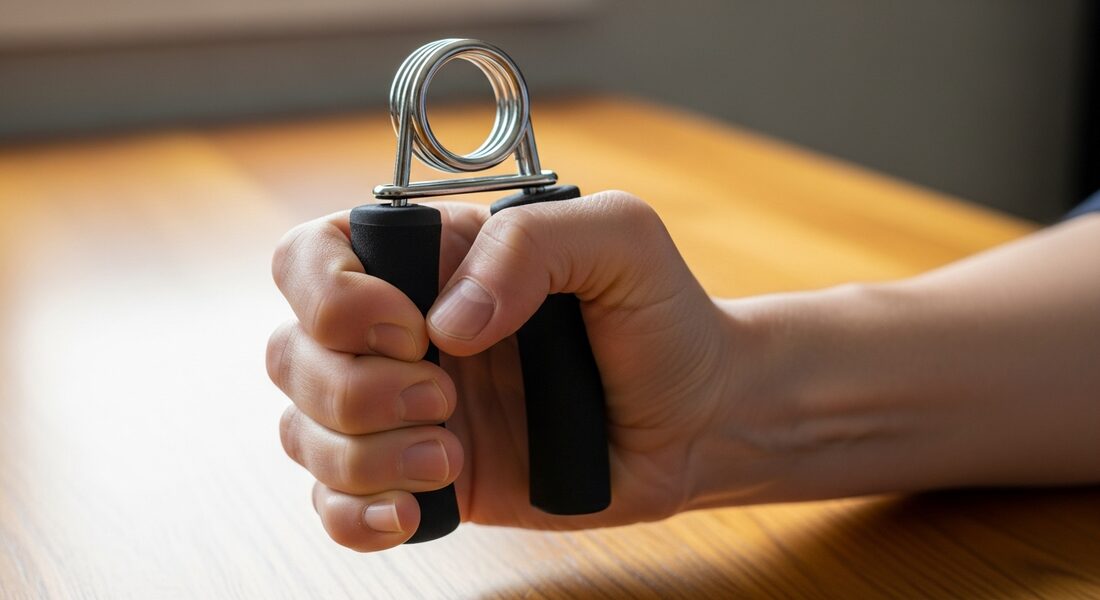
Gripmaster Pro — the standard for independent finger training
Individual finger buttons, four resistance levels, trains both flexion and extension. Best starting point for stroke survivors with partial hand return.
Check Current Price on Amazon ↗The Gripmaster Pro addresses what most grip tools miss: individual finger strengthening. After stroke, finger extensors and intrinsics are often disproportionately weak compared to finger flexors — and most grip tools train flexion only, reinforcing the imbalance. The Gripmaster trains each finger independently, with individually weighted buttons that can be set to different resistances per digit.
Available in four resistance levels (1.5 lb, 3 lb, 5 lb, 7 lb per finger). Most stroke survivors in early hand recovery start at 1.5 lb. Don't let ego push you to 3 lb before you've earned it — quality of extension matters as much as grip force.
Dynaflex Pro Gyroscopic Hand Exerciser
Wrist and grip endurance through gyroscopic resistance. Requires some wrist extension to start — mid-to-late recovery tool.
Check Current Price on Amazon ↗The Dynaflex gyroball is a different stimulus than the Gripmaster — it trains grip endurance and wrist stability through resistance that scales with rotational speed. You start slow, build RPM, and the ball creates an angular momentum load on the wrist and forearm that's surprisingly effective for rebuilding the stabilizer muscles that get neglected in most stroke hand rehab.
The catch: you need sufficient hand function to initiate the gyro. It requires a wrist flick to start. If your wrist extension is minimal, this isn't the right tool yet. Once you have that — mid-to-late recovery, or chronic phase — the Dynaflex is a genuinely useful addition to a grip program.
IronMind Captains of Crush Trainer — for late-recovery grip building
100 lb closing resistance, premium spring, all-aluminum. Late-recovery grip strengthener once basic hand function is restored.
Check Current Price on Amazon ↗The Captains of Crush (CoC) Trainer is the lightest of the IronMind CoC line (100 lb closing resistance) and is the appropriate tool once you're building toward functional grip strength — not relearning movement patterns, but actually loading the hand for strength gains. The all-aluminum construction and spring quality is noticeably better than most consumer grip trainers.
Context check: 100 lb resistance sounds mild. Post-stroke, it's not. Most people with full hand function find the Trainer challenging. Use this when you can close it cleanly for 10 reps on the affected side — until then, the Gripmaster or theraputty work is the right sequence.
FitBeast Digital Grip Strength Trainer Kit — measurable progress
Digital tester + adjustable gripper + finger exerciser. Measures progress numerically. Also in the Recovery Store.
Check Current Price on Amazon ↗Most grip tools give you no feedback. You squeeze, you hope it is getting stronger, and you guess. The FitBeast kit replaces guessing with numbers: a digital grip strength tester that measures force in real time, plus an adjustable gripper (22–132 lbs) and individual finger exerciser. The tracker is the motivator — when you see the number climb from 15 lbs to 35 lbs, the invisible process becomes visible.
Use the digital tester once per week as a benchmark. Do your daily grip and finger work with the adjustable gripper and finger exerciser. Track the weekly number. Progress is not always felt, but it is always measurable.
Marcy Wrist and Forearm Developer — the overlooked prerequisite
Wedge-style wrist and forearm trainer. Compact desk use. The overlooked prerequisite to functional grasp. Also in the Recovery Store.
Check Current Price on Amazon ↗Wrist control is prerequisite to functional grasp, but most stroke hand rehab skips it. The Marcy Wrist and Forearm Developer trains wrist flexion, extension, and rotation against adjustable resistance. The compact wedge design sits on a desk or table — no gym required.
Use it before grip work: 2 sets of 15 reps each direction (flexion, extension, pronation, supination). A stable wrist makes every grip exercise more effective and reduces compensatory shoulder elevation.
Programming grip work into your recovery routine
Three sessions per week, not daily. The hand needs recovery time — tendinitis is a real risk if you over-train an already-compromised neuromuscular system. Two to three sets of 10–15 reps per session. Active rest between sets — don't clench the hand, do light finger extension stretches.
Track both sides. The goal is closing the asymmetry ratio — if your strong hand grips at 80 lbs and your affected hand grips at 20 lbs, you're at 25% symmetry. Progress means that ratio improving. Absolute strength is less meaningful than symmetry for most stroke outcomes.
Frequently asked questions
Can grip strengtheners make spasticity worse?
Yes, if used in the wrong phase. Loaded grip work on a hand dominated by flexor spasticity reinforces the pattern. Wait until you have voluntary finger extension against gravity before introducing resistance tools. If in doubt, ask your OT.
How often should I do grip exercises after stroke?
Three times per week. The hand is small but the tendon load is real. Daily grip work with resistance tools risks overuse injury in a hand that may have reduced sensation and won't give you normal pain warning signals. Rest days are not optional.
What if I can't even hold the grip tool?
Start with theraputty (see our hand therapy tools post). Putty allows very low resistance, full ROM work, and individual finger isolation. It's the step before grip tools for most stroke survivors with minimal hand return.
My affected hand cramps during exercises. Is that normal?
Muscle cramping during grip work post-stroke is common and usually indicates working at too high a resistance for too long. Back off to a lighter tool, shorter sets, longer rest periods. Persistent or painful cramping warrants a conversation with your OT or neurologist.
Will grip strengtheners help with fine motor skills like buttons?
Partially. Grip strength is a prerequisite for fine motor function, but fine motor skill requires additional precision training — pinch exercises, manipulation tasks, peg boards. A full OT home program covers both. Grip tools are one component, not the whole program.
Gripmaster Pro Hand Exerciser
Check Current Price on AmazonHand recovery is covered in detail in the book
THE ULTIMATE STROKE RECOVERY REVOLUTION dedicates a full section to upper extremity recovery — the sequence, the tools, and the mindset required to rebuild a hand that a stroke tried to take.
Get the bookStart your recovery free.
Daily routine. AI coach. 66-day challenge. Built by a survivor for survivors.
Create free account