Parallel bars for stroke recovery at home
I walked in parallel bars at a clinic for three months. Then I installed a set in my garage. The difference was immediate — daily practice, no commute, and the confidence to push past the limits of a 45-minute PT session.
Why parallel bars matter for stroke gait recovery
Parallel bars are the single most effective piece of gait training equipment for stroke survivors. They provide bilateral support so the survivor can focus on the walking pattern without fear of falling. The hands grip the bars, the body is supported, and the brain can concentrate on the motor sequence — heel strike, stance, push-off, swing — without the cognitive load of balance.
In clinics, parallel bars are the first surface most survivors walk on after stroke. The problem is time — a 45-minute PT session with 10 minutes on the bars is not enough to trigger the neuroplasticity that rewires the gait pattern. The solution is daily practice at home, and the only way to do that is to install parallel bars where you live.
Progymnastic Parallel Bars — the $400 portable option
The Progymnastic parallel bars are a portable, adjustable-height set that assembles in 15 minutes and breaks down for storage. The height adjusts from 30 to 50 inches — low enough for seated transfers, high enough for standing gait training. The width adjusts from 18 to 24 inches — narrow for small spaces, wide for larger gait patterns.
For stroke survivors, the Progymnastic bars are the best entry point. They are portable, so they work in apartments, garages, and basements. The height range accommodates every stage of recovery — seated, kneeling, standing, and full gait. At $400, they are the cheapest legitimate parallel bars on the market. The trade-off is stability — they are not as rigid as bolted clinical bars, but they are more than adequate for home use.
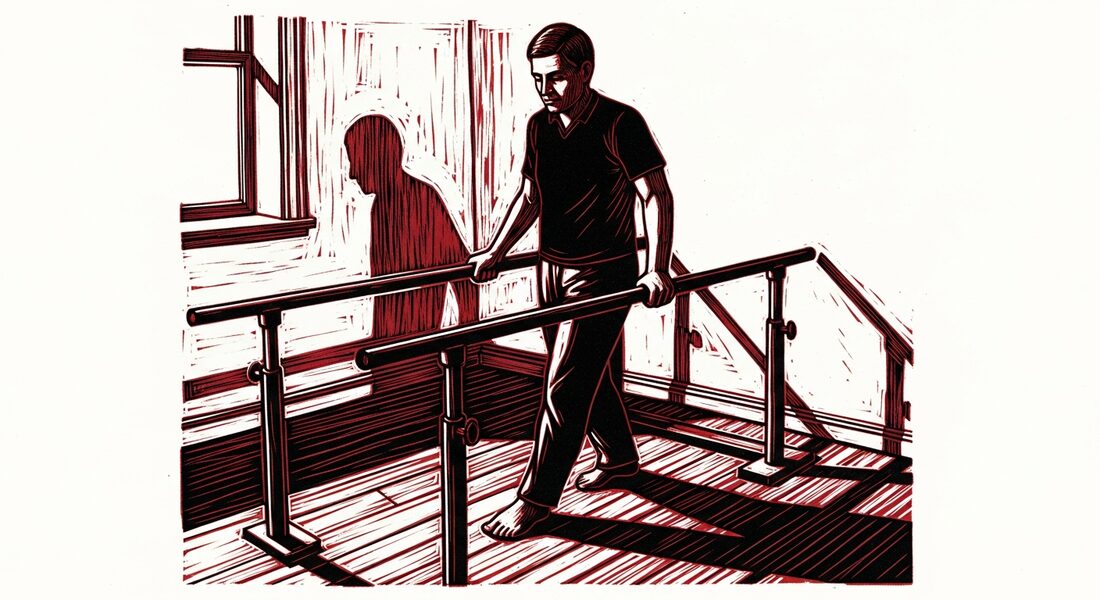
- Adjustable height — 30 to 50 inches, works for every recovery stage
- Adjustable width — 18 to 24 inches, fits small spaces and wide gait patterns
- Portable assembly — 15 minutes to set up, breaks down for storage
- 400-lb capacity — accommodates most survivors plus a therapist spotting
- Non-slip feet — rubber pads for stability on hard floors and carpet
Portable, adjustable-height parallel bars for home gait training. The best entry point for stroke survivors — assembles in 15 minutes, breaks down for storage.
Check Current Price on Amazon ↗Drive Medical Stand-Assist Parallel Bars — the $800 clinical-grade option
The Drive Medical stand-assist parallel bars are the clinical-grade option for home installation. The base is a heavy steel frame with rubber feet — no assembly, no wobble, no movement. The height is fixed at 36 inches, which is the standard clinical height for adult gait training. The width is 24 inches, which is the standard clinical width.
For stroke survivors, the Drive Medical bars are the right choice when stability is the priority — when the survivor is full-weight-bearing but still needs the security of rigid bars. The fixed height means the bars are always at the same level, which is critical for motor learning — the brain learns the motor pattern better when the environment is consistent. The price is $800 — double the Progymnastic, but the stability is worth it for survivors who are training daily and need zero movement.
Clinical-grade steel-frame parallel bars with fixed height and width. The most stable option for daily home gait training — zero movement, zero wobble.
Check Current Price on Amazon ↗The exercises that actually work in parallel bars
The parallel bars are not just for walking. They are a full-body training platform. The exercises that work: weight shifting — stand between the bars, shift weight from the affected side to the unaffected side, repeat 20 times. Heel-to-toe walking — walk the length of the bars with the heel of the front foot touching the toe of the back foot. Single-leg stance — stand on the affected leg, hold the bars for balance, build up to 30 seconds.
The progression: start with weight shifting, add heel-to-toe walking, add single-leg stance, add side-stepping, add backward walking. The parallel bars make every exercise safe — the hands are always on the bars, the fall risk is zero, and the survivor can focus on the motor pattern.
The setup I recommend — and the one I actually use
I started with the Progymnastic bars at $400. I used them daily for six months in the garage — 20 minutes every morning before the walk. The portable design meant I could move them when the car needed the space, and the adjustable height meant I could lower them for seated exercises and raise them for standing gait training.
At month six, I upgraded to the Drive Medical fixed bars at $800. The stability difference was real — the fixed bars did not move, and my brain learned the motor pattern faster because the environment was consistent. I kept the Progymnastic bars for travel and for the garage when the car needed the space. Both are in the garage now. The Drive Medical bars are the daily workhorse.
| Model | Price | Type | Best for | Key feature |
|---|---|---|---|---|
| Progymnastic Bars | $400 | Portable, adjustable | Month 1–6, travel, garage | Folds flat, height 26–48 in |
| Drive Medical Heavy Duty | $800 | Fixed, clinical-grade | Month 6+, daily gait training | 1000 lb capacity, powder coat |
| Hausmann Free-Standing | $1,200 | Fixed, extra-long | Advanced gait training | 12 ft rails, 48 in width |
Frequently asked questions
How much space do parallel bars need at home?
The Progymnastic bars need 6 feet of length and 3 feet of width — about the size of a large hallway or a garage bay. The Drive Medical bars need 8 feet of length and 3 feet of width. The walking surface is the length of the bars — 4 to 6 feet of usable walking space is the minimum for effective gait training.
Can I use parallel bars if I have significant balance deficits?
Yes — that is the point. The parallel bars provide bilateral support so the survivor can focus on the walking pattern without the cognitive load of balance. The hands grip the bars, the body is supported, and the brain can concentrate on the motor sequence. Start with weight shifting and heel-to-toe walking, then progress to single-leg stance and side-stepping.
Are portable parallel bars stable enough for daily use?
The Progymnastic bars are stable for most home use. The rubber feet grip hard floors and carpet. The 400-lb capacity is sufficient for most survivors. The trade-off is some movement under heavy load — the Drive Medical fixed bars are better for survivors who need zero movement. Both are safe when used correctly.
How long should I use parallel bars each day?
I used 20 minutes every morning — 10 minutes of weight shifting and heel-to-toe walking, 5 minutes of single-leg stance, 5 minutes of side-stepping. The key is consistency, not intensity. 20 minutes daily for 6 months is more effective than 60 minutes once a week.
When do I stop using parallel bars and walk without support?
When you can walk the length of the bars without touching them for balance. That is the exit criteria — the hands are on the bars, but they are not gripping. The body is walking independently. The bars are there for safety, not support. When that happens, move to a cane, then a walker, then nothing. The parallel bars are a bridge — not a destination.
What is the cheapest parallel bar setup for home use?
The Progymnastic bars at $400 are the cheapest legitimate option. The Drive Medical bars at $800 are the cheapest clinical-grade option. Do not build DIY parallel bars — the stability and height adjustment matter for safety. A wobbly bar is a fall risk. The $400 Progymnastic bars are the minimum safe investment.
Can I use parallel bars if I am in a wheelchair?
Yes — the Progymnastic bars can be set low enough for seated exercises. The Drive Medical bars can also be set low. The seated exercises: weight shifting from side to side, leg lifts, and standing practice from the seated position. The parallel bars are not just for walking — they are a full-body platform. Even if you are in a wheelchair, the bars support the transition to standing and walking.
Do parallel bars help with foot drop after stroke?
Yes — the heel-to-toe walking exercise in the parallel bars is the most effective practice for foot drop. The bars provide the balance support so the survivor can focus on the dorsiflexion motion — lifting the toe before placing the heel. The repetition retrains the brain. The bars make the repetition safe. The combination is the foot drop protocol that works.
What is the best surface for parallel bars at home?
Hard floor is best — concrete, tile, or hardwood. Carpet is acceptable but the rubber feet may slip slightly under heavy load. The garage is ideal — flat, hard, and spacious. Avoid uneven ground or outdoor surfaces. The bars must be level for safe gait training. Use a bubble level when assembling the Progymnastic bars.
Can I use parallel bars for upper body exercises after stroke?
Yes — the parallel bars are a full-body platform. Upper body exercises: dip-assisted push-ups (lean into the bars, push back), tricep dips (hold the bars, lower the body, push back up), and shoulder press (push down on the bars to lift the body). The bars support the body weight so the exercises are safe for survivors with reduced strength.
Progymnastic Parallel Bars — the home gait training bridge
Portable, adjustable-height parallel bars that assemble in 15 minutes. The best entry point for home gait training at $400.
Check price on AmazonThe full gait-rebuilding system
THE ULTIMATE STROKE RECOVERY REVOLUTION covers the gait training protocol, the parallel bars setup, the daily routine, and the mindset that takes you from bars to open ground.
Get the bookStart your recovery free.
Daily routine. AI coach. 66-day challenge. Built by a survivor for survivors.
Create free account