Reciprocal motion. Zero impact. Real cardio. The elliptical is underrated for hemiparetic survivors who need to rebuild endurance without wrecking joints.
This is written by Nick Kremers, who was paralyzed by a stroke, spent three years in a wheelchair, and rebuilt his way back to walking, typing, and training again. He built Stroke Recovery Academy out of that wheelchair, and everything on this page is filtered through what actually worked in his own recovery and the recoveries of the survivors he now coaches. Read his full story →
Best value elliptical for stroke recovery. Fixed inner handlebars, wide footpads, 20 resistance levels. Affiliate link.
| Product | Why It Made The List | |
|---|---|---|
| Top Pick Schwinn 430 Elliptical | Fixed inner handlebars, 20 resistance levels, wide footpads. Best all-around value for stroke recovery use. | Check Price → |
| Nautilus E616 Elliptical | 29 resistance levels, built-in programs, smoother flywheel than Schwinn 430. Good for mid-to-late recovery when intensity matters. | Check Price → |
| Niceday Elliptical Exercise Machine | 16-inch stride, 16-level magnetic resistance, 400 lb capacity. Compact footprint ideal for home stroke recovery cardio. See the direct Amazon listing. | Check Price → |
Seven years post-stroke, the elliptical is still in my weekly rotation. Here's why it made the list over a treadmill for many survivors: the reciprocal arm-leg cross-body motion forces the brain to coordinate both sides simultaneously — exactly the bilateral integration that neuroplasticity research says matters. Zero impact on the knee and ankle means compensated gait patterns don't get reinforced the way they can on a treadmill. And the moving handlebars give a hemiparetic arm something to do that isn't just hanging there.
Caveat upfront: if you have significant balance deficits or can't weight-shift laterally without losing balance, a recumbent bike is the safer starting point. The elliptical requires standing balance. Come back to it once that's more stable.
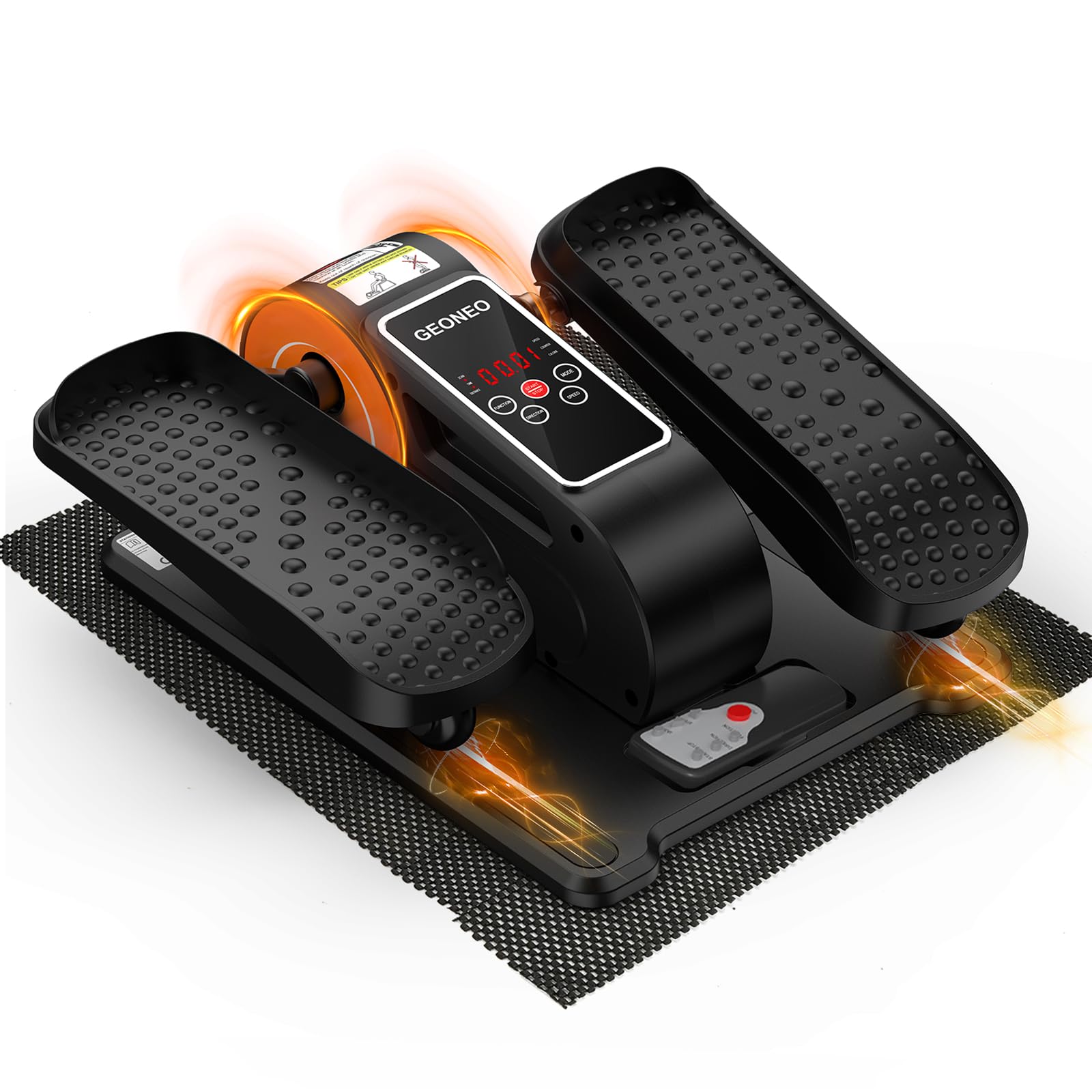
Handrail stability: Fixed stationary handles alongside the moving poles. You need something to grab if balance fails mid-session. Not all ellipticals have them. This is non-negotiable for stroke survivors in early-to-mid recovery.
Step-through design: A low step-up height is essential if you have hip flexor weakness or foot drop. High center-mount designs where you step up and over a bar are an injury waiting to happen with a hemiparetic leg.
Adjustable stride length: Hemiparetic gait is asymmetric. A shorter stride (16–18") is often better than the standard 20" for stroke survivors — it lets the affected leg cycle through without requiring full hip extension you may not have yet.
Resistance range: You want both ends — low enough to start at near-zero resistance as the affected side builds, high enough to actually challenge you six months from now.
All three ellipticals below are recommended in this guide. Use the table to match the machine to your space, stride, and stage, then read the full write-ups.
| Product | Best for | Key spec | Approx. price |
|---|---|---|---|
| Schwinn 430 Elliptical | Best all-around value for most survivors | 20 resistance levels, fixed inner handlebars, wide footpads, 20" stride | See current price |
| Nautilus E616 Elliptical | Mid-to-late recovery when intensity matters | 29 levels, 22 programs, smoother flywheel, cadence tracking | See current price |
| Niceday Elliptical | Small spaces and limited hip extension | 16" stride, 16 magnetic levels, 400 lb capacity, compact | See current price |
The Schwinn 430 hits every requirement: 20 levels of resistance (genuinely wide range), fixed inner handlebars alongside the moving poles for grab-and-go stability, a 20" stride length that can be adjusted by stride pace, and a step-up height that works for most stroke survivors with a single step. The footpads are wide and the toe cages are removable — important if foot drop means you need your foot sitting flat rather than strapped in.
The built-in programs are mostly irrelevant for stroke rehab. What matters: manual mode, set a timer, go slow enough that the affected arm actually participates instead of being dragged by momentum from the strong side. That takes conscious practice.
Fixed inner handlebars, 20 resistance levels, wide footpads. Best all-around value for stroke recovery use.
Check Price on Amazon →Short on time? Schwinn 430 Elliptical is the one Nick recommends first.
Check Price on Amazon →The Nautilus E616 is a step up in build quality and data. Twenty-nine resistance levels, 22 built-in programs including interval options, a 20" stride with a smoother magnetic flywheel feel than the Schwinn 430 at the same price tier. The console tracks strides per minute — useful if your PT has given you a target cadence for gait retraining.
The E616 has the same fixed inner handlebar design. The footpads have a slight tilt that some survivors with ankle instability find uncomfortable — try before buying if possible, or verify the return window before ordering.
29 resistance levels, built-in programs, smoother flywheel than Schwinn 430. Good for mid-to-late recovery when intensity matters.
Check Price on Amazon →The Niceday Elliptical packs a 16-inch stride and 16-level magnetic resistance into a compact footprint that fits in most apartments and home gyms. The 400 lb loading capacity means stability is not a concern even for larger survivors. The shorter stride (16" vs 20") can be an advantage for stroke survivors with limited hip extension — the affected leg does not need to reach as far to complete the cycle.
The tradeoff: no moving handlebars, so the bilateral arm-leg coordination benefit of a full-size elliptical is reduced. If you are using the elliptical primarily for leg cardio and will do arm work separately (resistance bands, hand therapy), this is a reasonable compromise for the space savings.
16-inch stride, 16-level magnetic resistance, 400 lb capacity. Compact footprint ideal for home stroke recovery cardio. See the direct Amazon listing.
Check Price on Amazon →The biggest mistake is letting the strong side do all the work. Watch your affected arm at the pole — it should be pushing and pulling, not riding passively. If it's going limp, slow down until you can actively drive it. Quality of bilateral engagement beats duration every time.
Start with 10 minutes at low resistance. Build by 5 minutes per week if you tolerate it. Heart rate monitoring matters — post-stroke cardiovascular deconditioning is real, and a 40-minute aerobic session requires slow progression to get there safely.
If you have foot drop: keep resistance low enough that the foot doesn't get caught in the back of the stride. Wear your AFO if your PT recommends it for uneven terrain — the same logic applies to an elliptical footpad.
Bilateral arm training post-stroke — Cochrane Review · Aerobic exercise in stroke rehabilitation — Stroke journal
Yes, with modifications. Keep resistance low so the affected foot can complete the stroke cycle without catching. Wear your AFO if your orthotist approves it for exercise. Start slow — literally 2–3 mph equivalent — and watch the foot placement on every stroke until the pattern is reliable.
For most stroke survivors in the first 1–2 years: yes. No impact means joint stress doesn't compound compensated movement patterns. The reciprocal cross-body motion adds neuroplasticity value. Treadmills are better for direct gait retraining — but that's usually a clinical setting with a PT, not a home machine.
Use the fixed inner handlebar on the strong side for stability. Drape the affected arm over the moving pole loosely and let gravity do what it will — even passive movement is more input than nothing. As grip and shoulder function improve, transition to active participation.
In early recovery: yes. Have someone present for the first several sessions. In mid-to-late recovery with stable balance: many survivors use one independently. But have a phone within reach and a clear fall plan before going solo.
Current cardio guidelines for stroke survivors: 150 minutes of moderate aerobic activity per week, broken into manageable sessions. That's 20–30 minutes five days a week, or 50 minutes three days a week. Build to it — don't start there.
Reciprocal motion. Zero impact. Real cardio. The elliptical is underrated for hemiparetic survivors who need to rebuild endurance without wrecking joints.