Best Weighted Vests for Stroke Balance Training and Gait Rehab
Adding body weight through a vest changes the proprioceptive input during walking and balance work — a different neuroplasticity stimulus that complements standard exercise without requiring different equipment.
Why weighted vests for stroke recovery
The research on weighted vests for post-stroke gait comes primarily from studies using trunk weighting — adding load at the trunk or affected shoulder to improve trunk symmetry and gait pattern. The mechanism: increased proprioceptive input through the trunk and lower extremities during weight-bearing enhances sensory feedback that post-stroke hemiplegia has disrupted. More feedback means more material for the nervous system to use in recalibrating motor patterns.
Weighted vests are also used for general strength conditioning during recovery-phase walking — adding load to gait without requiring separate equipment or a gym. As walking capacity improves and the same distance feels too easy, a vest is the lowest-friction way to increase the training stimulus.
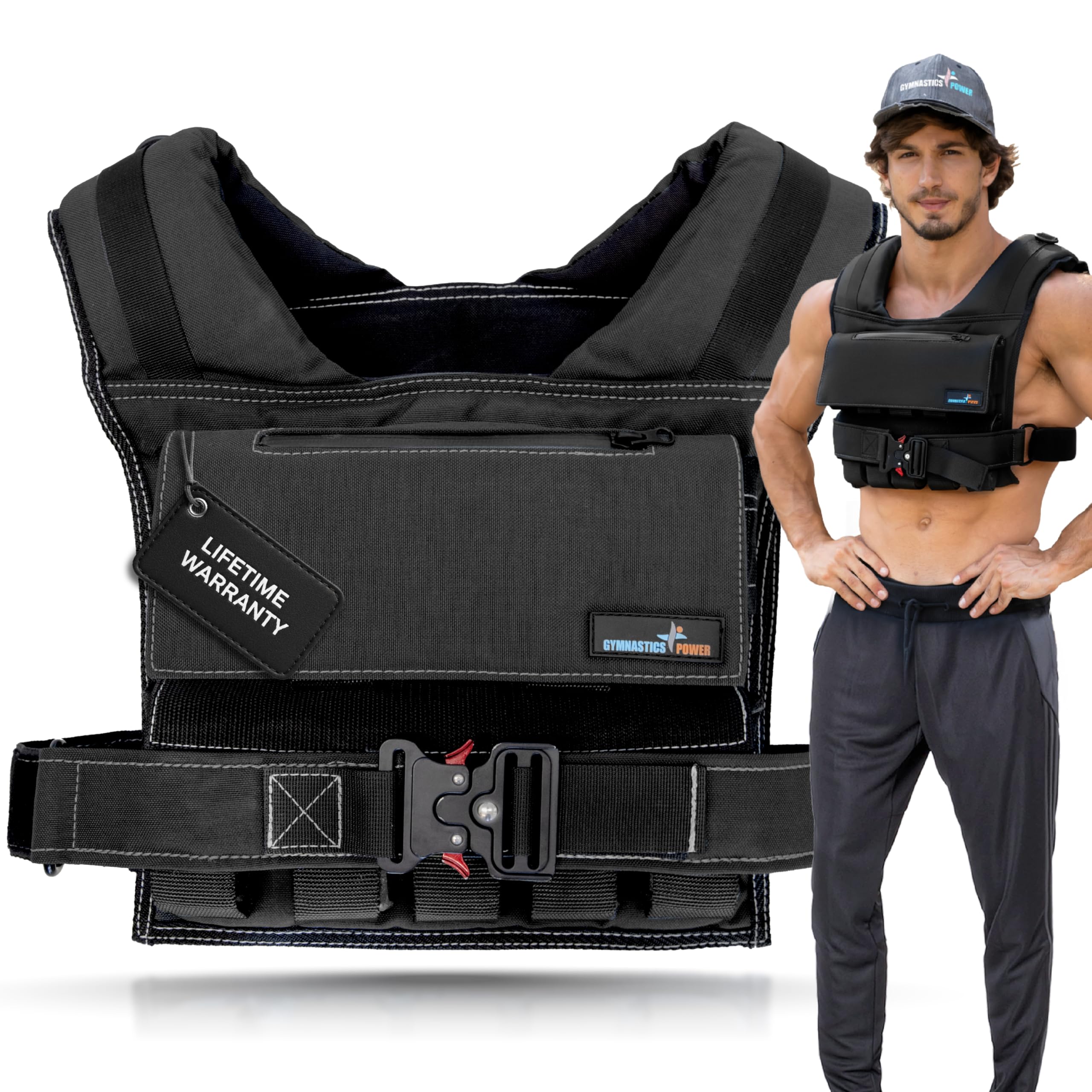
ZFOsports Weighted Vest — best adjustable option
Adjustable iron ore packets, symmetric trunk loading, 20/40/60 lb versions. Most PT-referenced weighted vest for stroke gait and balance training.
Check Current Price on Amazon ↗The ZFOsports vest is the most-reviewed adjustable weighted vest in the stroke and neurological rehabilitation communities. The weight is distributed in small iron ore packets across the front and back — load is balanced symmetrically across the trunk, which matters for survivors already managing asymmetric weight distribution. Available in 20 lb, 40 lb, and 60 lb versions with the ability to add or remove individual weight packets.
Start with 2–4% of body weight, which is the range most PT research on post-stroke weighting uses. For a 180 lb survivor, that's 3.6–7.2 lbs — the 20 lb vest with partial loading covers this range and has room to progress.
Henkelion Weighted Vest — the comfortable all-day option
Softer construction, even weight distribution, fixed-weight versions 6–20 lb. Better for all-day wear comfort vs. ZFOsports for session-specific training.
Check Current Price on Amazon ↗The Henkelion vest uses a softer construction with smaller, more uniformly distributed steel shot weights. It's less adjustable than the ZFOsports but more comfortable for extended wear during daily activity or longer walking sessions where the ZFOsports' rigid pockets become irritating. Available in 6 lb, 8 lb, 12 lb, 16 lb, and 20 lb fixed weights.
For survivors using the vest as an all-day proprioception aid rather than a specific exercise tool, the Henkelion's wearability advantage matters. For survivors using it specifically during training sessions with a clear target weight, the ZFOsports' adjustability is more valuable.
How to use a weighted vest during stroke recovery — the protocol
Clinical studies use 2–4% of body weight during walking and balance tasks. Start at the lower end, walk your normal route or use your treadmill, and assess how it affects your gait quality and fatigue the next day. If gait quality degrades significantly — more list, more circumduction, worse foot clearance — the weight is too high. If the next-day fatigue is significantly worse than usual, reduce load.
Progression: add small increments (half to one pound) every 1–2 weeks as you tolerate the current load without gait degradation. The goal is a training stimulus, not a gait disruptor. Never use a weighted vest if your balance is marginal — add it only when your unweighted balance and gait are stable enough that the added load is a challenge, not a hazard.
Frequently asked questions
Is a weighted vest safe for stroke survivors?
With appropriate weight selection and stable baseline balance: yes. The contraindications: significant active balance deficits that make falls a real risk, cardiovascular instability, or cervical/thoracic spine issues where added trunk load is contraindicated. Get PT clearance before adding a weighted vest to your training if you're in the first 12 months post-stroke.
How much weight should I put in my vest for stroke recovery?
2–4% of body weight is the research-supported range for gait improvement and proprioceptive training. For a 160 lb survivor: 3.2–6.4 lbs. Start at the lower end and progress slowly. The vest should add challenge without disrupting the gait quality you've worked to develop.
Can weighted vests help with balance after stroke?
The evidence for trunk weighting specifically improving balance and gait symmetry post-stroke is positive, particularly for asymmetric trunk lean patterns. Multiple RCTs show improved Fugl-Meyer balance subscores, Berg Balance Scale scores, and gait symmetry with trunk-targeted weighting. The effect is modest but consistent.
Should the weight be centered on my affected side?
Some clinical protocols use asymmetric weighting — more weight on the affected side to correct lateral lean toward the stronger side. This is a clinically guided intervention, not a self-prescription. If your PT has given you a specific weighting protocol, follow it. For general training without specific guidance, symmetric weighting (equal front and back, equal left and right) is appropriate.
Can I wear a weighted vest on a treadmill after stroke?
Yes, if you're cleared for solo treadmill use at baseline and the vest doesn't degrade your treadmill gait quality to an unsafe degree. Weighted treadmill walking is a progression — add it after you're stable with unweighted treadmill use, not simultaneously with learning to use the treadmill.
ZFOsports Weighted Vest
Check Current Price on AmazonBalance and gait training in the book
THE ULTIMATE STROKE RECOVERY REVOLUTION covers the balance retraining progression, the neuroplasticity mechanisms behind it, and the tools that accelerate it without requiring a clinical setting.
Get the bookStart your recovery free.
Daily routine. AI coach. 66-day challenge. Built by a survivor for survivors.
Create free account