Best walker for stroke survivors
A walker is not just a frame with wheels. For a hemiparetic survivor, it is a transfer aid, a balance anchor, and a psychological permission slip to try walking again. Here is how to choose.
Why standard walkers fail stroke survivors
A standard walker requires bilateral grip and equal push through both arms. Most stroke survivors do not have that. The weak-side hand may grip lightly or not at all, which causes the walker to tilt toward the affected side — exactly the wrong direction.
Stroke-specific walker needs: stand-up support handles (so you can pull yourself from sitting without yanking furniture), a wide base that does not tip when loaded unevenly, height adjustability that accounts for the hemiplegic posture (often slightly stooped on the affected side), and rubber tips that grip hard floors without skidding.
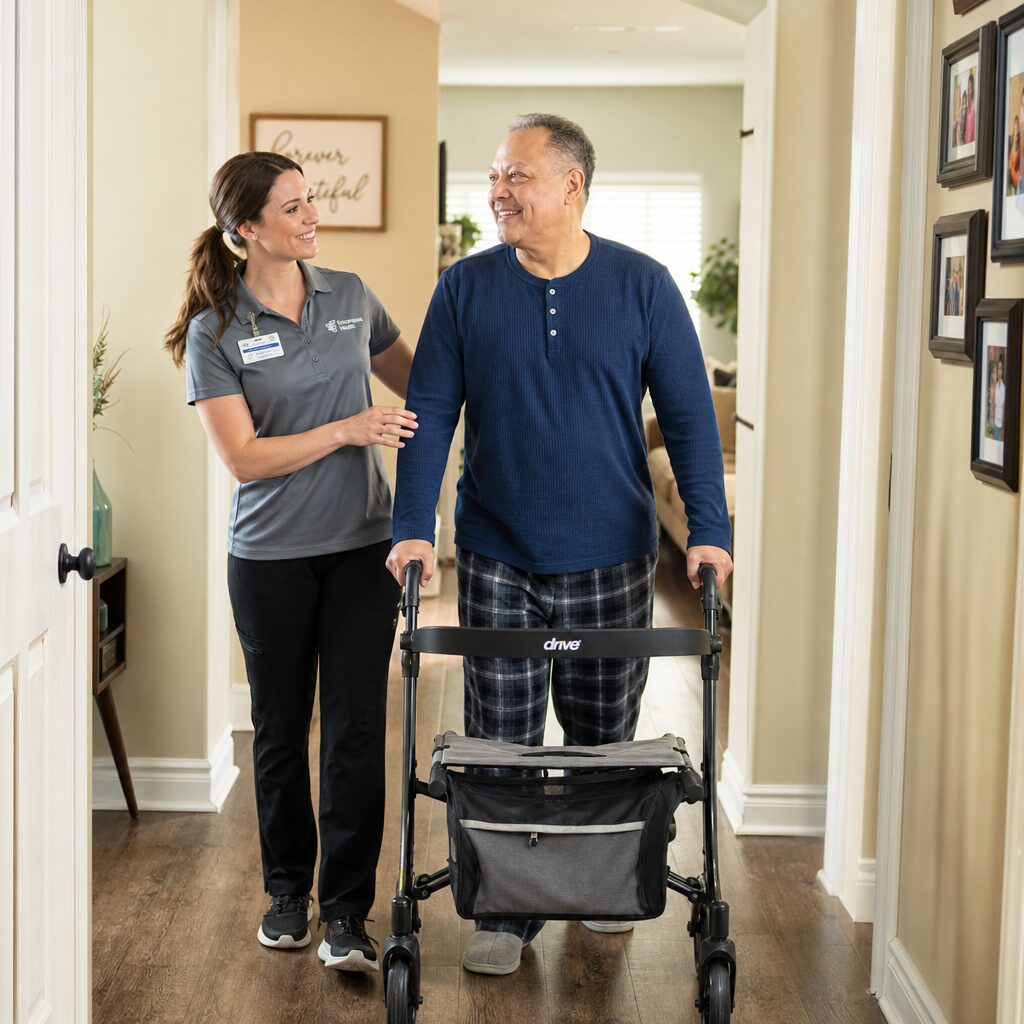
Stand-up support: the feature that changes everything
The single most useful walker feature for early-stage survivors is a set of horizontal grips at hip height that let you pull yourself upright from a chair or bed before starting to walk. Without them, you are reaching for furniture, doorframes, or a caregiver's arm — all of which create fall risk and shoulder strain.
Stand-up grips also serve as a resting point during walking practice. If fatigue hits mid-hallway, gripping the horizontal bar gives a stable pause without having to find a chair. That changes how much practice you can do in a single session.
Recommended walker for stroke survivors
Height-adjustable frame with stand-up support handles and non-slip rubber tips. Designed for safe transfers and stable ambulation. Also in the Recovery Store.
Check Current Price on Amazon ↗Walker height and the hemiplegic posture
Standard walker height advice — top of grips at wrist crease with arms at sides — assumes symmetrical posture. Stroke survivors often have shoulder droop on the affected side, which lowers the wrist crease and leads to a walker set too low.
A walker set too low causes the survivor to lean forward, increasing kyphosis and reducing the visual field. A walker set too high causes shoulder elevation and reduces weight-bearing through the legs. Measure from the unaffected side's wrist crease, then verify that both elbows are flexed 20–30 degrees when gripping.
- Measure from the unaffected side's wrist crease
- Elbows flexed 20–30 degrees at the grip
- Eyes forward, not looking down at the floor
- Affected shoulder supported, not hanging or shrugging
When to move from walker to rollator or cane
The walker is a stage, not a destination. Most survivors transition to a rollator (4-wheeled walker with seat) when ambulation distance increases beyond what the standard walker allows comfortably — typically 50–100 feet at a time.
The transition to a cane happens when balance is reliable on flat surfaces and the walker is being used more for confidence than for mechanical support. Your PT should clear this transition with a functional gait assessment. Do not rush it.
Frequently asked questions
Can I use a walker if my affected hand has no grip?
Yes — choose a walker with a wide base and rubber tips that grip the floor even when loaded unevenly. The unaffected hand does most of the steering and braking. Some survivors add a forearm platform attachment to the affected side so the arm rests and steers without requiring hand grip.
Should a walker have wheels or be static?
Front wheels only for early-stage survivors. Full wheels (rollator) require more dynamic balance control. A static walker (no wheels) is the safest starting point because it stops when you stop. Progress to front-wheel when your PT clears dynamic balance work.
How wide should a walker be for a stroke survivor?
Wide enough that the base does not tip when the survivor leans toward the affected side. Most standard walkers are 25–28 inches wide. If the survivor has significant lateral sway, a bariatric-width frame (30+ inches) adds stability at the cost of fitting through doorways. Measure your narrowest doorway before buying.
Can I use a walker on carpet?
Yes, but rubber tips matter more on carpet than on hard floors because the drag is higher. Non-slip rubber tips with deep tread patterns work best. Avoid walkers with plastic or smooth rubber tips on carpet — they slide unpredictably.
TAMUBAKS Adjustable Medical Walker with Stand-Up Support
Stand-up grips for safe chair-to-standing transfers, adjustable height, and non-slip rubber tips. The walker built for hemiparetic survivors.
Check Current Price on AmazonThe gait rebuild is in the book
THE ULTIMATE STROKE RECOVERY REVOLUTION covers the complete mobility toolkit — walkers, rollators, canes, and the daily routine that keeps recovery moving forward.
Get the bookStart your recovery free.
Daily routine. AI coach. 66-day challenge. Built by a survivor for survivors.
Create free account