Best TENS Units for Stroke Recovery
Hemiplegic shoulder pain affects up to 84% of stroke survivors. Electrical stimulation is one of the most evidence-backed interventions. Here's what to buy and how to use it safely.
TENS vs. NMES — know which one you actually need
TENS (transcutaneous electrical nerve stimulation) manages pain by modulating sensory nerve signals. It doesn't cause muscle contraction — it changes pain perception. NMES (neuromuscular electrical stimulation) uses higher current to cause actual muscle contractions and is used for motor re-education. Many consumer devices do both — but the programs and electrode placement are completely different for each application.
For hemiplegic shoulder pain: TENS is the primary tool. For motor re-education of the shoulder girdle or hand (FES-type use): NMES/EMS programs. For spasticity management: some evidence for TENS and NMES both, though the mechanism differs. Know what you're treating before you set up the device.
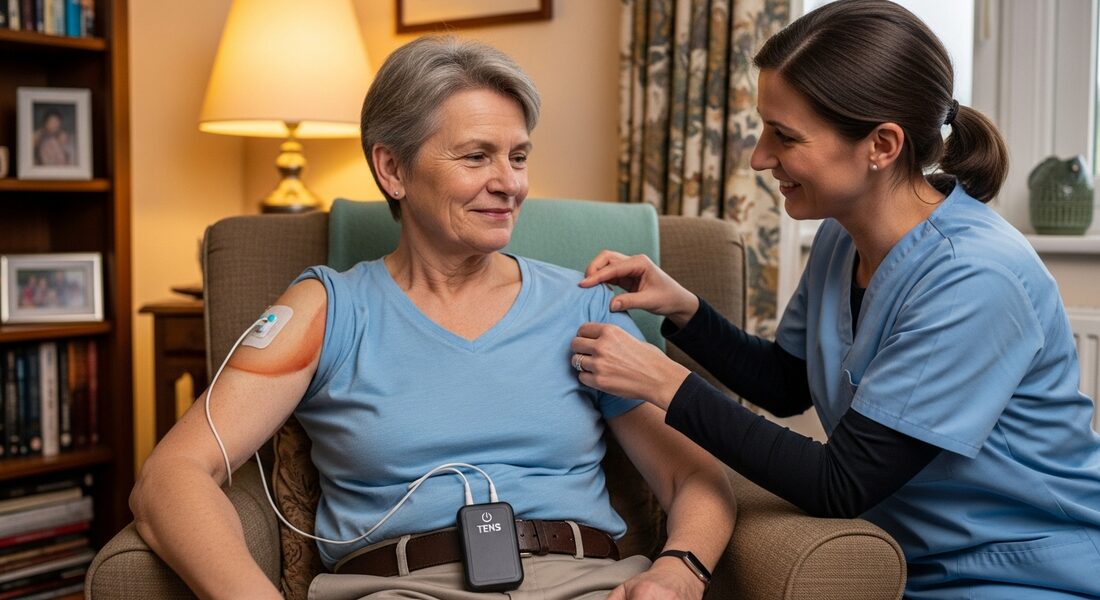
Safety first — electrode placement you must avoid
Absolutely do not place electrodes: over the carotid artery (front of the neck), over a cardiac pacemaker or ICD, over the eyes, on broken or irritated skin, or transthoracically (one electrode on each side of the chest, passing current through the heart). For stroke survivors specifically: avoid placement over areas of significantly impaired sensation — you won't feel if the current is too high, which is how skin burns happen.
If you have hemiplegic shoulder subluxation (the shoulder joint is partially dislocated — very common post-stroke), get specific electrode placement from a PT or physiatrist before self-treating. The shoulder capsule geometry changes with subluxation and standard placement guides may not apply.
TENS 7000 — the clinical standard at home price
Clinical-standard consumer TENS unit. Dual channel, 5 modes, 0–100 mA. Most PT-recommended device for home post-stroke shoulder pain management.
Check Current Price on Amazon ↗Same TENS 7000 unit with full accessory bundle: pads, leads, carrying case. Ready to use immediately. Also in the Recovery Store.
Check Current Price on Amazon ↗The TENS 7000 is used in more physical therapy clinics than any other consumer-grade unit. It has been for years. The reason isn't marketing — it's that the machine works, the controls are simple, the intensity range is adequate for post-stroke shoulder pain, and the pads and leads are available everywhere. Five modes (Normal, Burst, Modulation, SD1, SD2), 0–100 mA output, dual-channel independent control.
For post-stroke shoulder pain, most PTs recommend starting with Normal mode, intensity at the threshold of sensation without muscle contraction, 20–30 minutes per session. The TENS 7000 bundle includes pads, leads, and a carrying case.
iReliev ET-5050+ — TENS + EMS combo for motor re-education
25 programs, TENS + EMS, rechargeable, better pad quality than TENS 7000. Best choice if you need both pain management and motor re-education.
Check Current Price on Amazon ↗The iReliev ET-5050+ does TENS and EMS (equivalent to NMES for most stroke applications) in one device. Twenty-five programs, dual channel, rechargeable. The EMS programs are where this device earns its place — if your PT has prescribed electrical muscle stimulation for shoulder girdle motor re-education or is trying to reduce spasticity through reciprocal inhibition protocols, having dedicated EMS modes matters.
The electrode quality on the included pads is better than the TENS 7000 bundle. The device is slightly more complex to operate — the extra modes require learning the menu system. For survivors who want the full TENS + EMS toolkit in one unit, this is the best value in the category.
PowerDot 2.0 Duo — smart TENS/NMES for app-guided use
App-guided TENS/NMES with Bluetooth. Best for survivors who want program guidance over manual settings. Requires phone — consider accessibility.
Check Current Price on Amazon ↗The PowerDot 2.0 Duo is Bluetooth-connected and app-controlled. For stroke survivors who want guided programs rather than manual settings, the PowerDot app provides electrode placement guides, program selection, and intensity progression. The app-guided approach reduces the learning curve that trips up some survivors with the manual TENS 7000 or iReliev menus.
The caveat: app-dependency. The PowerDot requires a phone to operate — no manual override. If fine motor limitations make phone interaction difficult, the hardware buttons on the TENS 7000 or iReliev are more accessible. Also significantly more expensive.
Frequently asked questions
Will TENS help my hemiplegic shoulder pain?
For most survivors: yes, for pain management during use. The Cochrane review shows TENS reduces hemiplegic shoulder pain acutely. Whether it changes the underlying subluxation or joint mechanics is a separate question — it doesn't. But managing pain enough to participate in rehab and sleep is not a small thing.
Can TENS or NMES help me regain movement after stroke?
NMES/FES with voluntary effort (the EMG-triggered approach) has the strongest evidence for motor re-education — similar to the robotic glove mechanism. Passive NMES has moderate evidence for spasticity reduction. Standard TENS is pain management, not motor rehab. The category matters.
Do I need a prescription for a TENS unit?
In the US: no, for consumer units like the ones listed here. Prescription-grade devices (like Bioness L300 for drop foot or specific FES systems) require a prescription. Standard TENS for pain management is OTC. Insurance reimbursement is a different story — check your plan before expecting coverage.
How often should I use a TENS unit for shoulder pain?
Most PT protocols for hemiplegic shoulder pain: 30–60 minutes once or twice daily, during and after exercise sessions when pain is worst. TENS is not a substitute for shoulder positioning, subluxation management, and progressive loading — it's an adjunct.
Can I use TENS if I have a pacemaker or other implanted device?
No — not without explicit clearance from your cardiologist. The electromagnetic interference from TENS can affect pacemaker function. This is not a precaution to ignore. Absolute contraindication absent specific cardiology clearance.
TENS 7000 Digital TENS Unit
Check Current Price on AmazonPain management is covered in the book
THE ULTIMATE STROKE RECOVERY REVOLUTION covers hemiplegic shoulder pain, spasticity, and the integrated approach to managing both while keeping momentum in recovery.
Get the bookStart your recovery free.
Daily routine. AI coach. 66-day challenge. Built by a survivor for survivors.
Create free account