Best massage gun for stroke recovery and spasticity relief
Percussion massage before your PT session can reduce tone enough to get meaningful work done. After exercise it accelerates recovery. But there are areas you must avoid — and a technique that makes the difference.
Why percussion therapy for stroke survivors
Vibration and percussion stimulate Golgi tendon organs — mechanoreceptors that signal muscle lengthening and trigger inhibitory reflexes that reduce muscle tone. That's the mechanism behind the anecdotal experience of using a massage gun on a spastic calf and having the foot easier to dorsiflex for the next 20–30 minutes. The effect is temporary, but temporary is enough to get therapeutic range of motion work done.
The research on percussion specifically (vs. vibration) for post-stroke spasticity is thin but growing. The anecdotal evidence from stroke survivor communities is consistent: pre-exercise percussive massage to the affected arm or leg reduces tone enough to make subsequent exercises more effective. It's a warm-up tool, not a cure.
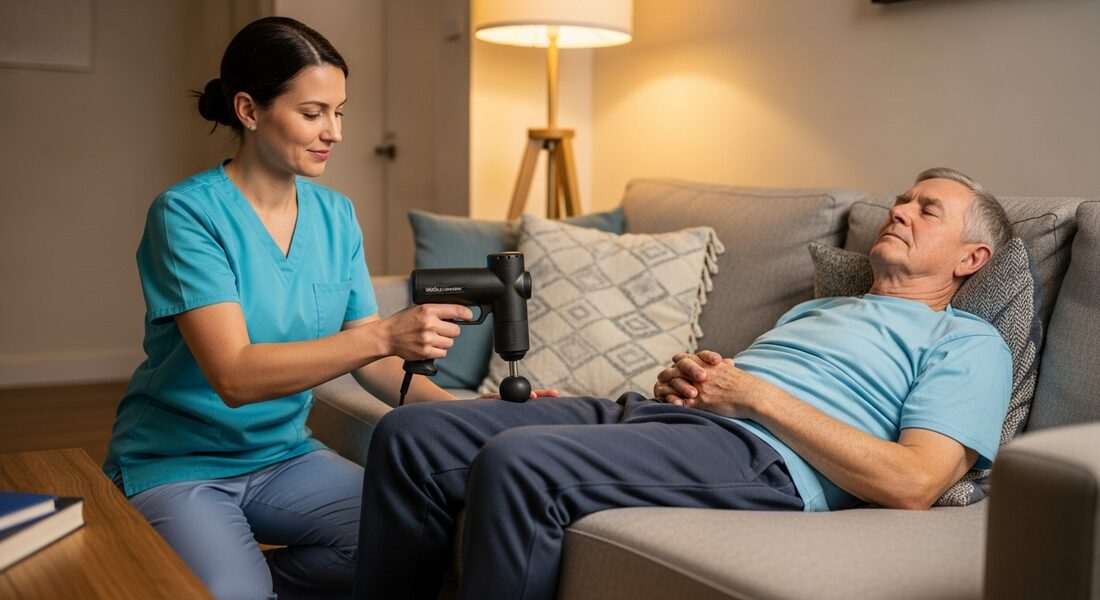
Where not to use a massage gun — non-negotiable
Never use a massage gun over: bony prominences (spine, shoulder blade edges, hip bones), the carotid artery or anterior neck, areas of significantly reduced sensation (you can't feel if you're causing injury), areas with broken skin, bruising, or recent surgical sites, the anterior knee over the patella, or directly over an implanted device. For stroke survivors specifically: avoid the cranium and the posterior neck near the brainstem.
Use only on muscle bellies with the lowest amplitude setting first. Build up from there. If you don't feel the sensation on the affected side, have someone confirm placement is on muscle tissue before increasing intensity.
Theragun Pro — the clinical standard
16mm amplitude, 60 lb stall force, 6 attachments, one-handed rotating arm. Clinical-standard device for spasticity pre-treatment and muscle recovery.
Check Current Price on Amazon ↗The Theragun Pro is used in sports medicine and physical therapy clinics because the amplitude (16 mm) and force (60 lbs stall force) are calibrated for real tissue work, not superficial vibration. It comes with six attachments — the soft ball and dampener are the correct choices for post-stroke spastic muscle work; avoid the cone attachment on spastic tissue. The OLED display with pressure indicator prevents over-application.
One-handed operation is possible — the rotating arm and ergonomic handle are genuinely designed to reach the contralateral side. For stroke survivors doing self-treatment on the affected limbs, this matters more than it sounds.
Hypervolt 2 — the best mid-range option
12mm amplitude, 3 speeds, 5 attachments, quieter than Theragun. Best mid-range option for survivors with functional strong-side arm.
Check Current Price on Amazon ↗The Hypervolt 2 sits below the Theragun Pro in amplitude (12 mm vs 16 mm) and stall force (40 lbs vs 60 lbs), but is still genuinely effective for post-stroke spasticity warm-up and muscle recovery work. Three speed settings, five attachments, Bluetooth for app integration (optional — works without the app). Quieter than the Theragun, which matters if noise or vibration sensitivity is an issue post-stroke.
The handle geometry is not as optimized for one-handed self-treatment as the Theragun Pro's rotating arm. If you have significant upper extremity involvement on both sides, the Theragun Pro's ergonomics are worth the price premium. If your strong arm is fully functional, the Hypervolt 2 is excellent value.
Frequently asked questions
Will a massage gun reduce my spasticity permanently?
No. The tone reduction is temporary — typically 20–45 minutes. The value is using that window for effective range-of-motion work, stretching, or exercise that would be harder to do at baseline tone. Stack it before therapy, not instead of therapy.
Can I use a massage gun on my spastic hand?
With caution and low amplitude only. The hand has very little muscle belly to work with and many bony prominences to avoid. Use the soft ball attachment at the lowest speed on the forearm flexors (the muscle belly in the forearm, not the hand itself) to reduce distal tone. Direct percussion on the hand is generally not recommended.
Is it safe to use a massage gun near my stroke-affected areas?
Avoid the cranium and neck. Everything else — with the bony landmark exclusions listed above — is generally safe on muscle bellies. The key safety factor for stroke survivors is sensation impairment: if you can't feel the device on the affected side, have someone monitor the skin for redness or pressure marks and keep sessions to 60–90 seconds per muscle group.
What's the difference between percussion and vibration for spasticity?
Amplitude and tissue depth. Percussion (massage guns) delivers higher amplitude, higher force impacts — better at reaching deeper muscle tissue. Vibration plates or handheld vibrators operate at higher frequency with lower amplitude — better for sensory input and some proprioceptive work. Both have evidence for temporary spasticity reduction; for self-treatment, percussion guns are more practical.
Do I need the Theragun Pro or will a cheaper massage gun work?
A mid-range device (Hypervolt 2 or Theragun Elite) is sufficient for most stroke survivors. The Pro is worth the upgrade if: you're doing self-treatment with one hand and need the rotating arm ergonomics, you want the pressure display to prevent over-application on insensate tissue, or you're using it daily in a clinical-adjacent context. Budget is better spent elsewhere if the Hypervolt 2 handles your needs.
Theragun Pro Percussive Therapy Device
Check Current Price on AmazonSpasticity management is in the book
THE ULTIMATE STROKE RECOVERY REVOLUTION covers the full spasticity management stack — from positioning and splinting to electrical stimulation and beyond.
Get the bookStart your recovery free.
Daily routine. AI coach. 66-day challenge. Built by a survivor for survivors.
Create free account