Strength & Cardio

Best resistance bands after stroke

Looking for the best resistance bands after stroke? Start with the lightest useful tension, a grip you can control, and exercises that do not reinforce compensation.

Why Trust This Guide

This is written by Nick Kremers, who was paralyzed by a stroke, spent three years in a wheelchair, and rebuilt his way back to walking, typing, and training again. He built Stroke Recovery Academy out of that wheelchair, and everything on this page is filtered through what actually worked in his own recovery and the recoveries of the survivors he now coaches. Read his full story →

Key Takeaways
  • The Resistance Band Set rebuilt Nick's left side for about $20 before any dumbbell.
  • Bands beat weights early because they load safely without dropping on you.
  • Choose light resistance first and follow the same order Nick used.
  • Bands can be used carefully with spastic muscles when you avoid overloading.
  • Six daily exercises bridge you from bands to the gym as you progress.
Top Pick My Pick

Resistance Band Set for Stroke Recovery

Light to heavy loop and tube bands with handles. The exact progression I used to rebuild strength before touching a dumbbell.

Affiliate link — I earn a small commission at no extra cost to you.

At A Glance

How These Compare


ProductWhy It Made The List
Top Pick
Resistance Band Set for Stroke Recovery
Light to heavy loop and tube bands with handles. The exact progression I used to rebuild strength before touching a dumbbell.Check Price →
Lianjindun 5-Piece Professional Resistance Band SetLatex-free resistance bands with five tension levels. Includes loop and tube bands with handles. See the direct Amazon listing.Check Price →

Why bands beat weights early in recovery


Free weights are dangerous for stroke survivors in the first 6–12 months. The affected side has poor coordination, reduced grip strength, and altered proprioception. A dumbbell that slips is a fracture or a concussion. A resistance band that slips is a rubber band on the floor.

Bands also provide variable resistance. The resistance is lowest at the start of the motion (where the muscle is weakest) and highest at the end (where the muscle is strongest). This matches the strength curve of a recovering muscle far better than a fixed-weight dumbbell.

Resistance band sets compared at a glance


Both sets below appear in this post. Use the table to decide quickly, then read the details before buying.

Resistance band sets compared — standard set for value, latex-free set for sensitive skin.
ProductBest forKey specApprox. price
Resistance Band Set for Stroke RecoveryThe exact progression Nick used to rebuild strength before dumbbellsLight-to-heavy loop and tube bands with handlesAbout $20
Lianjindun 5-Piece Professional SetLatex-sensitive skin during recoveryLatex-free, five tension levels, loop + tube bands with handlesSee current price

The types I used and the order I used them


I started with a light loop band (the flat circular kind) for lateral leg raises. Then I added a tube band with handles for seated rows, bicep curls, and shoulder presses. Then I added a heavier loop band for squats and standing abduction. The progression was gentle, measurable, and safe.

  • Light loop band (red or yellow) — hip abduction, lateral leg raises, ankle dorsiflexion
  • Tube band with handles (light resistance) — seated rows, bicep curls, shoulder press
  • Medium loop band (green or black) — squats, standing abduction, glute bridges
  • Heavy tube band (medium resistance) — lat pulldowns, chest press, tricep extensions

Latex-free band option


Some stroke survivors develop skin sensitivity or latex allergy during recovery. Standard latex bands can cause irritation, rashes, or contact dermatitis. A latex-free set eliminates this risk while providing the same progressive resistance training.

Lianjindun 5-Piece Professional Resistance Band Set

Latex-free resistance bands with five tension levels. Includes loop and tube bands with handles. See the direct Amazon listing.

Check Price on Amazon →
Quick Answer

Short on time? Resistance Band Set for Stroke Recovery is the one Nick recommends first.

Check Price on Amazon →

Safety rules for survivors


Never anchor a band to a door without a proper door anchor. Never stand on a band with bare feet — it will slip. Never use a band that is frayed or cracked. Start with 2–3 sets of 10–15 reps. Rest 60–90 seconds between sets. If you feel pain that is sharp or joint-level, stop. If you feel fatigue that is muscular, continue.
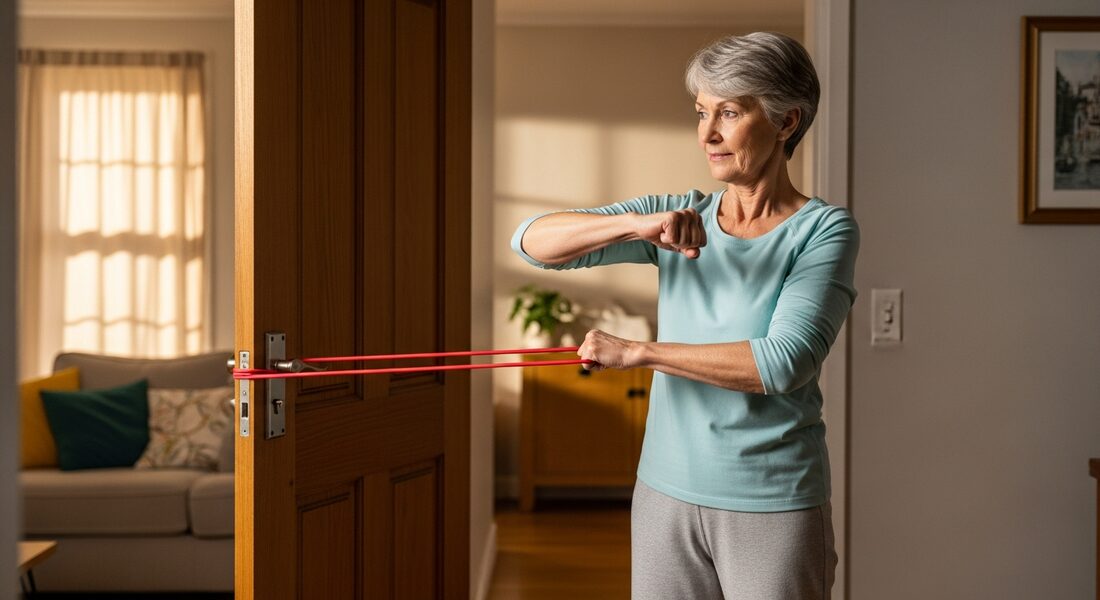
Stroke survivor doing arm exercises with a resistance band at home
Bands provide variable resistance — lowest where the muscle is weakest, highest where it is strongest.
  • Buy bands if: you are in the first 6–18 months, you want a safe way to load the affected side, or you travel and need portable resistance.
  • Buy the latex-free set if: you have developed skin sensitivity, a rash, or a known latex allergy during recovery.
  • Skip bands (for now) if: you cannot yet grip a handle or loop safely on the affected side — start with hand therapy and grip work first.
  • Add weights instead if: you are past 12–18 months, cleared by your PT, and bands no longer challenge you at their heaviest tension.

The 6 exercises I used every single day


These are the six band exercises that formed the core of my early home strength program. I chose them because they hit the movements that matter most for daily function: pulling yourself up, pushing something away, walking stability, and getting off a chair.

  • Seated row (tube band with handles): improves posture, scapular control, and the ability to pull open doors. Anchor at knee height. Pull both handles to your chest.
  • Bicep curl (tube band, one or both arms): rebuilds elbow flexion for lifting and carrying. Stand on the band. Curl slowly.
  • Terminal knee extension (loop band above knee): critical for knee stability and reducing gait deviations. Stand in slight knee bend, band provides resistance to straightening.
  • Hip abduction (loop band above knee, lying or standing): targets the hip stabilizers that prevent hip drop during walking — one of the most common gait problems after stroke.
  • Shoulder external rotation (tube band at elbow height): prevents shoulder impingement on the affected side, often caused by muscle imbalance from spasticity.
  • Seated leg press simulation (loop band, foot through loop): plantarflexion and dorsiflexion from a chair — great for ankle and foot control without weight-bearing risk.

Progressing from bands to the gym


I moved to a gym at month fourteen. I had a physical therapist evaluate my form with the basic movements before I touched any machine. The form issues that bands did not catch — subtle hip shift during squats, shoulder elevation during rows — were caught immediately when a trained eye watched me. Do not skip the evaluation. A compensatory movement pattern at the gym becomes a chronic injury by month eighteen.

The transition order that worked: bands for the first year, cable machines for the next six months (cables mimic band physics), then barbells and dumbbells. The cable machine is underused by survivors — it provides smooth, weight-stack resistance with many of the safety advantages of a band.

Frequently Asked Questions

Common Questions


Can resistance bands replace weights entirely?

For the first 12–18 months, yes. After that, most survivors benefit from adding light weights. Bands remain useful for warm-ups, mobility work, and travel. I still use bands daily for shoulder prehab and hip activation.

How do I know which resistance level to start with?

Start with the lightest band. You should be able to complete 15 reps with good form. If you can do more than 20, move to the next band. If you cannot do 8, drop to a lighter band.

Are bands safe for spastic muscles?

Yes, but with caution. Spastic muscles fatigue faster and can cramp. Use lighter resistance, fewer reps, and longer rest periods. Stretch after, not before. If the muscle cramps, stop and stretch gently.

What exercises should I avoid with bands?

Avoid high-risk positions: standing on a band while pulling upward (fall risk), banded neck exercises (cervical injury risk), and any exercise where the band is anchored at face level. Keep it simple: rows, curls, presses, raises, squats.

Related Reading

Keep Going


Keep Moving Forward

Strength & Cardio — Full Guide

Looking for the best resistance bands after stroke? Start with the lightest useful tension, a grip you can control, and exercises that do not reinforce compensation.