Recommended mirror therapy box
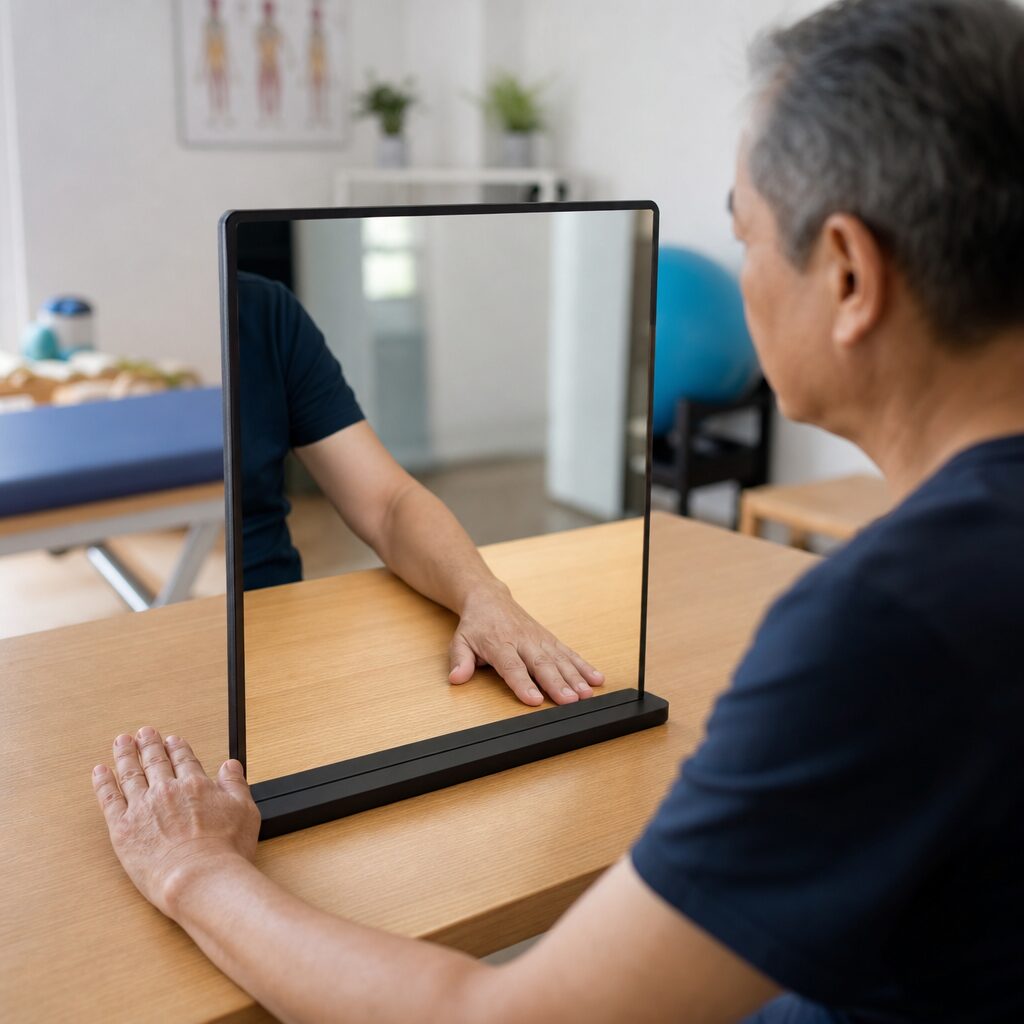
ODOXIA Mirror Therapy Box for Stroke Recovery
Portable mirror box designed for consistent mirror therapy setup. See the direct Amazon listing.
Check Price on Amazon →Mirror therapy is one of the most evidence-backed, low-cost methods for hand recovery after stroke. A $40 box and 15 minutes a day can produce measurable cortical change. Here is how it works and how to do it right.
This is written by Nick Kremers, who was paralyzed by a stroke, spent three years in a wheelchair, and rebuilt his way back to walking, typing, and training again. He built Stroke Recovery Academy out of that wheelchair, and everything on this page is filtered through what actually worked in his own recovery and the recoveries of the survivors he now coaches. Read his full story →
Portable mirror box for consistent daily mirror therapy — the evidence-backed method for hand reactivation after stroke.
Curated by Nick Kremers. As an Amazon Associate, SRA earns from qualifying purchases at no extra cost to you.
Mirror therapy exploits a quirk of the brain's visual-motor system. When you watch your unaffected hand move in a mirror, the brain sees what looks like the affected hand moving. That visual illusion activates the motor cortex on the affected side — the same area that was damaged by the stroke.
The mechanism is called visual feedback motor imagery. The brain does not distinguish perfectly between real movement and mirrored movement. Repeated sessions create new neural pathways that bypass the damaged area, gradually restoring voluntary control to the affected hand.
The evidence is strong. Multiple randomized controlled trials show significant improvements in hand function, spasticity, and pain after 4–6 weeks of daily mirror therapy. It is recommended in clinical practice guidelines for upper limb rehabilitation after stroke.
Portable mirror box designed for consistent mirror therapy setup. See the direct Amazon listing.
Check Price on Amazon →Short on time? ODOXIA Mirror Therapy Box for Stroke Recovery is the one Nick recommends first.
Check Price on Amazon →Mirror therapy is not a substitute for active hand exercises. It is a preparation and facilitation tool. The visual activation it creates must be followed by real movement attempts — putty work, grip training, functional tasks — to convert cortical activation into motor skill.
It also will not work if the survivor cannot see clearly or has significant visual field neglect (hemianopia) on the affected side. In those cases, the mirror image may not register in the brain's visual system, and the therapy produces limited benefit.
I started mirror therapy at month four, after my OT introduced it in a single session. I was skeptical — it felt like watching a magic trick, not doing real rehab. But the first time I saw my left hand (in the mirror) open and close while my real left hand lay still behind the glass, I felt something in the affected forearm twitch.
I used a simple hand mirror for the first two weeks, then bought a mirror box to keep the setup consistent. By week six I could initiate a slow finger open on the affected side without the mirror — something I had not been able to do since the stroke. It was not dramatic. It was a millimeter of movement. But it was real, and it was the first voluntary movement I had felt in four months.
Mirror therapy is not exciting. It is quiet, repetitive, and requires patience. But the evidence is real, the cost is low, and for many survivors it is the first thing that produces a genuine cortical response in the affected hand.
Most studies show measurable improvements after 4–6 weeks of twice-daily 15-minute sessions. Individual results vary by stroke severity, time since stroke, and consistency. The key variable is daily practice — missing days reduces the effect significantly.
Yes — a hand mirror or any vertical mirror works. The mirror box is convenient because it holds the mirror at the correct angle and provides a stable base, but it is not medically necessary. A $10 bathroom mirror propped on a table produces the same visual feedback.
It is safe for most, but contraindicated for survivors with severe visual neglect (hemianopia) on the affected side who cannot process the mirror image, or those with severe cognitive impairment who cannot follow the protocol. Consult your OT before starting.
Before. Mirror therapy reduces cortical inhibition and primes the motor cortex for the active work that follows. The ideal sequence: 10–15 minutes mirror therapy, then 15–20 minutes of active hand exercises (putty, grip trainer, functional tasks).
Mirror therapy is one of the most evidence-backed, low-cost methods for hand recovery after stroke. A $40 box and 15 minutes a day can produce measurable cortical change. Here is how it works and how to do it right.